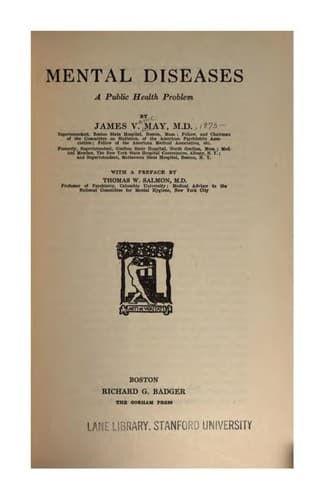
Mental diseases: a public health problemMay, James Vance
Science
Mental diseases: a public health problem
May, James Vance
Mental health services; Psychology, Pathological
just ready to begin the process of crystallization will have become the
diamond and the world will possess the psychopathic hospital of the
future."
Psychiatric research was inaugurated in this country by the
establishment of the Pathological Institute of the New York State
Hospitals in New York City in 1896. Its original field of investigation
was limited to the laboratory. The name was changed to "Psychiatric
Institute" on the appointment of Dr. Adolf Meyer as director in 1902
and the establishment was removed to Wards Island, where it was
provided with clinical facilities by the Manhattan State Hospital.
It thus became the precursor of the psychiatric clinic movement in
America. The observation wards for the examination and commitment of
mental cases, at the Philadelphia Hospital (1890) and at Bellevue in
New York City were probably the first of the kind in this country. In
1902 the first psychopathic wards connected with a general hospital
were opened by the Albany Hospital. Pavilion F, as it was designated,
admitted 3,132 patients during its first twelve and one-half years.
These included persons awaiting examination and commitment, voluntary
patients and cases of delirium, stupor, etc., transferred from other
wards of the hospital. Of 1,038 cases admitted during a period of six
years, only 17.6 per cent were committed to state hospitals. In a total
of 1,855 cases, twenty-five per cent were found to be suffering from
some form of alcoholism and twenty-six per cent from chronic mental
conditions, while thirty-five per cent were cases of the acute and
recoverable class. About fourteen per cent were psychoses associated
with renal conditions, neurasthenia, hysteria, tuberculosis or
traumatism.
Public-domain text, read in full here on John Shaqi.
Reviews
Reviews
No reviews yet
Be the first to share your thoughts on this work.
Elsewhere in the archive
Join the Discussion
Join the discussion
Sign in to leave a comment or review.
Sign InorCreate an account