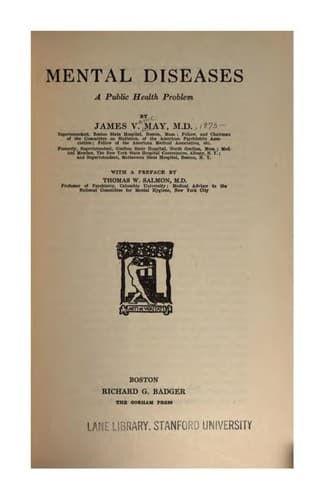
Mental diseases: a public health problemMay, James Vance
Science
Mental diseases: a public health problem
May, James Vance
Mental health services; Psychology, Pathological
The work of the out-patient service includes in a general way the study
of cases referred to that department from the wards of the hospital or
by its social service staff; cases referred by courts, schools, social
agencies, and other institutions, as well as those sent by practicing
physicians and individuals coming on their own initiative. The response
on the part of the public to the facilities offered by the out-patient
department is shown by the fact that 9,273 new cases were reported
during a seven-year period, an average of 1,324.7 per year. Fifty-seven
and six hundredths per cent of these cases were adults, 17.8 per cent
were classified as adolescents, 24.25 per cent as children and .89 per
cent as infants. The source of origin of these cases is exceedingly
interesting. Four and eighty-seven hundredths per cent were referred
to the out-patient service by courts; 4.65 per cent, by schools; 11.77
per cent, by hospitals; 9.77 per cent, by physicians; and 3.55 per
cent, by individuals. Fifteen and five tenths per cent came from the
wards of the Psychopathic Hospital; 9.96 per cent, from the social
service department and 13.3 per cent came on their own initiative.
The question as to why these cases are sent to an institution of the
psychopathic hospital type can now be answered. Fourteen and fifty-two
hundredths per cent were examined solely for the purpose of determining
the existence of probable mental diseases and 21.88 per cent on account
of suspected mental defects. Four and fifty-two hundredths per cent
were sex offenders. In 8.64 per cent the only question at issue was
the possibility of a psychoneurosis and in 7.97 per cent the purpose
of the examination was to ascertain whether or not syphilis was
present. The diagnoses show the nature of the cases encountered in an
out-patient mental clinic. Four and eighteen hundredths per cent were
cases of dementia praecox; 1.7 per cent of alcoholism; 2.26 per cent
of alcoholic psychoses; 2.39 per cent of epilepsy; 15.72 per cent of
mental deficiency; 9.0 per cent of psychoneuroses; 2.14 per cent of
manic-depressive insanity; 2.09 per cent of psychopathic personality;
1.21 per cent of general paresis; and 2.94 per cent were unclassified.
Two and thirty-two hundredths per cent were diagnosed as suffering
from syphilis in some form and 6.27 per cent were either delinquent,
defective, subnormal, retarded or distinctly feebleminded. In 3.76 per
cent no disease was found, either mental or physical. The great bulk of
these cases were diagnosed either as mental deficiency, psychopathic
personality or epilepsy. The ultimate disposition of 2,741 cases,
covering a period of two years, serves as an index of the practical
operation of such a department. In 42.03 per cent of these cases no
care or observation other than that of the out-patient department was
required. In 1.69 per cent of the cases commitment was recommended to
hospitals for mental diseases, in 7.15 per cent, to schools for the
Public-domain text, read in full here on John Shaqi.
Reviews
Reviews
No reviews yet
Be the first to share your thoughts on this work.
Elsewhere in the archive
Join the Discussion
Join the discussion
Sign in to leave a comment or review.
Sign InorCreate an account