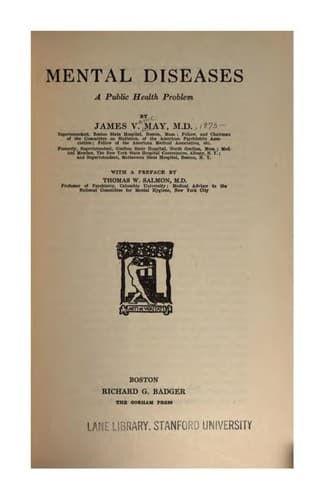
Mental diseases: a public health problemMay, James Vance
Science
Mental diseases: a public health problem
May, James Vance
Mental health services; Psychology, Pathological
feebleminded and in .11 per cent, to penal institutions. General or
psychopathic hospital care was recommended in 11.31 per cent. In 2.74
per cent of the cases a report was made to courts; in 1.61 per cent, to
schools; in 18.75 per cent, to social agencies; and in 1.13 per cent,
to physicians.
The functions of the social service department in a general way may be
summarized as follows:—1. The after care and supervision of patients
at home; 2. Advice to families of patients in regard to their cases;
3. Advice given other members of the family; 4. Financial relief; 5.
Reference to other social agencies or institutions; 6. Information
obtained for case histories; 7. Inquiries relative to home conditions
when discharge of a patient is under consideration, etc. The routine
operation of the department is well illustrated by the annual report
of the Boston State Hospital for 1920. The number under social service
supervision during the year was 428. Of these, 278 were new cases.
Thirty-two and thirty-seven hundredths per cent were referred by the
out-patient physicians; 59.71 per cent by the ward service; 7.19
per cent by other social agencies; and .73 per cent were brought by
relatives or friends. The principal reasons for their reference to the
social service workers were shown as follows:—For medical history,
50.36 per cent; assistance in securing employment, 9.35 per cent;
financial aid, 3.6 per cent; supervision, 7.2 per cent; advice, 19.42
per cent; convalescent care, 2.87 per cent; home care, 2.87 per cent,
etc. An analysis of the cases under supervision shows the principal
psychoses represented to be as follows:—Arteriosclerosis, 1.8 per
cent; general paresis, 4.68 per cent; alcoholic psychoses, 1.8 per
cent; manic-depressive psychoses, 4.68 per cent; dementia praecox,
16.55 per cent; paranoid conditions, 4.31 per cent; psychoneuroses,
9.35 per cent; undiagnosed psychoses, 6.84 per cent; and without
psychoses, 44.24 per cent. This latter group was made up mostly of
psychopathic personalities (28.45 per cent) and mental deficiency
(26.29 per cent). The purely social problems presenting themselves
in connection with these cases were reported as follows:—Mental
disease, 75.54 per cent; physical disease, 2.16 per cent; poverty,
2.88 per cent; criminality, 3.24 per cent; juvenile delinquency, 2.52
per cent; sex offenses, 2.16 per cent; alcoholism, 2.16 per cent;
family dissension, 6.12 per cent; ignorance, 2.52 per cent; and bad
environment, .36 per cent. In addition to this, 299 discharged soldiers
and 543 out-patient cases were reported as being under the supervision
of the department, as well as 532 special cases studied in connection
with the investigation of syphilis.
The Psychopathic Hospital in Boston started on a new chapter in its
history on December 1, 1920, at which time it was formally separated
from the Boston State Hospital and became a separate institution under
the direction of Dr. C. Macfie Campbell.
Public-domain text, read in full here on John Shaqi.
Reviews
Reviews
No reviews yet
Be the first to share your thoughts on this work.
Elsewhere in the archive
Join the Discussion
Join the discussion
Sign in to leave a comment or review.
Sign InorCreate an account