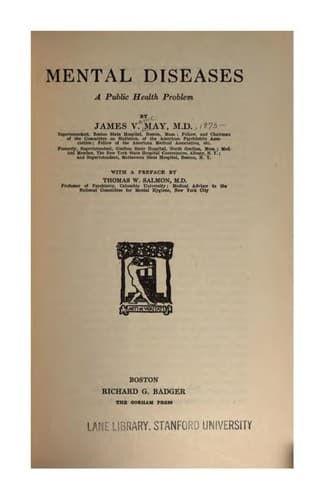
Mental diseases: a public health problemMay, James Vance
Science
Mental diseases: a public health problem
May, James Vance
Mental health services; Psychology, Pathological
The history of the movement to prevent the marriage of mental
defectives is more or less familiar to all. The sentiment of the
community is apparently not such at this time as to encourage the
regulation of the marriage of the mentally or physically unfit by
legislative restrictions. Attempts to do so have been almost a
flat failure. Various states have passed laws providing for the
sterilization of defective delinquents. These laws, generally speaking,
have accomplished nothing because public sentiment was not behind
them. All of these matters have been brought to the attention of the
public by prominent speakers on numerous occasions. Frequent articles
have been printed in medical journals, well-known periodicals, and even
in the daily papers. Attention has been called to the mental clinics
established here and there and repeated reference has been made to the
fact that physicians at our state hospitals may be consulted at any
time on questions pertaining to mental diseases or mental defects.
Something has been accomplished along these lines. It is unfortunate
that, as a rule, people look with more or less suspicion upon
institutions which are even now generally referred to as asylums. There
are many who still believe that every hospital for mental diseases
has its padded cells and underground dungeons. There is a rather
widespread idea that the most common causes of insanity are cigarette
smoking, religion and self abuse. Even in our most progressive
communities it has been difficult, if not impossible, to entirely
prevent the temporary detention, at least, of mental cases in jails
and police stations. Very few general hospitals have psychopathic
wards or any realization as to the necessity of establishing them.
It is not to be denied that in many states the care of the mentally
ill in our public institutions is far from being what it should be in
this enlightened day. These are conditions that cannot be remedied by
the medical profession without the active assistance of leaders of
public sentiment. The fact that the importance of these questions is
recognized by prominent educators, business men, lawyers, and other
persons active in the affairs of the community, and well known to the
public, will accomplish more than articles in the medical journals by
physicians. This constitutes the great field of the mental hygiene
organizations. They will mould public sentiment as nothing else ever
has, in matters which relate to the mental health of the country. They
will influence legislation where it is needed in a way that no medical
society can hope to do. Above all, they can in time bring the public
face to face with the fact that mental diseases should be discussed,
generally understood and prevented, instead of being merely concealed
and misrepresented. Possibly it would not be looking too far into the
future to express the hope that an organization composed largely of
laymen may be able eventually to accomplish something that the medical
Public-domain text, read in full here on John Shaqi.
Reviews
Reviews
No reviews yet
Be the first to share your thoughts on this work.
Elsewhere in the archive
Join the Discussion
Join the discussion
Sign in to leave a comment or review.
Sign InorCreate an account