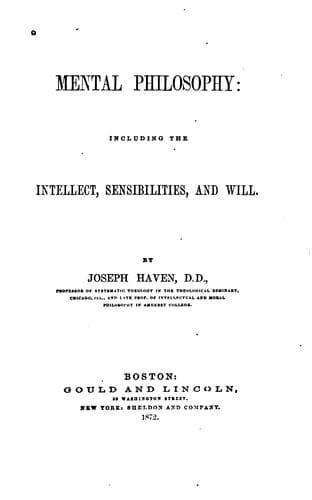
Mental Philosophy: Including the Intellect, Sensibilities, and WillHaven, Joseph
Philosophy
Mental Philosophy: Including the Intellect, Sensibilities, and Will
Haven, Joseph
Psychology
_Not a distinct Faculty._--The form of mental activity now described,
is hardly to be ranked as a distinct faculty of the mind, although it
has been not unfrequently so treated by writers on mental science.
It enters more or less fully into all mental operations; like
consciousness and attention, it is, to some extent, involved in the
exercise of all the faculties, and cannot, therefore, be ranked,
with propriety, as coördinate with them. It is not confined to the
investigations of science, but is an activity constantly exercised
by all men. We have in our minds a multitude of general conceptions,
the result of previous observation and thought. Every moment some new
object presents itself. With the quickness of thought, we find its
place among the conceptions already in the mind: it agrees with this,
it is incompatible with that, it belongs with the one, it is excluded
from the other. This is the form of most of our thinking; indeed,
no small part of our mental activity consists in this perception of
agreements and disagreements, and in the referring of some particular
object of experience, some individual conception, to the class or
general conception under which it properly belongs. The expression of
such a judgment is a proposition. We think in propositions, which are
only judgments mentally expressed. We discourse in propositions, which
are judgments orally expressed. We cannot frame a proposition which
does not affirm, or deny, or call in question, something of something.
_Judgment in relation to Knowledge._--Are judgment and knowledge
identical? Is all knowledge only some form of judgment? So Kant,
Tissot, and other writers of that school, would affirm. "Judgment is
the principal operation of the mind, since it is concerned in all
knowledge properly so called." "All our knowledges are judgments. To
know, is to distinguish, and to distinguish, is at once to affirm,
and to deny." Such was also Dr. Reid's doctrine, in opposition to
Locke, who distinguished between knowledge and judgment. Reid, on the
contrary, regards knowledge as only one class of judgments, namely,
those about which we are most positive and certain. According to this
view, judgment seems to cover the whole field of mental activity.
Sir William Hamilton thus regards it. We cannot even experience a
sensation, he maintains, without the mental affirmation or judgment
that we are thus and thus affected.
Public-domain text, read in full here on John Shaqi.
Reviews
Reviews
No reviews yet
Be the first to share your thoughts on this work.
Elsewhere in the archive
Join the Discussion
Join the discussion
Sign in to leave a comment or review.
Sign InorCreate an account