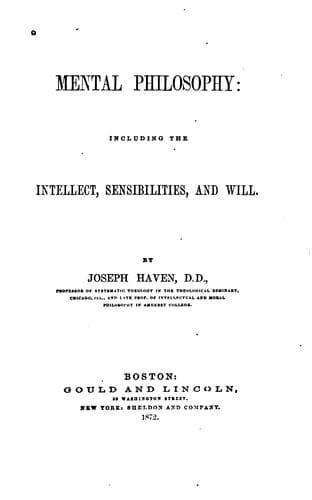
Mental Philosophy: Including the Intellect, Sensibilities, and WillHaven, Joseph
Philosophy
Mental Philosophy: Including the Intellect, Sensibilities, and Will
Haven, Joseph
Psychology
_Virtual Analysis of complex Conceptions._--Now when I affirm that the
table is round, I state one of the several qualities of the object so
called, one of the several parts of the complex notion. It is a partial
analysis of that complex conception. I separate from the whole, one of
its component parts, and then affirm that it sustains the relation of a
part to the comprehensive whole. The separation is a virtual analysis.
The affirmation is an act of judgment expressed in the form of a
proposition. Every proposition is, in fact, a species of synthesis,
and implies the previous analysis of the conception, or comprehensive
whole, whose component parts are thus brought together. Thus, when I
say snow is white, man is mortal, the earth is round, I simply affirm
of the object designated, one of the qualities which go to make up my
conception of that object. Every such statement or proposition involves
an analysis of the complex conception which forms the subject of
the proposition, while the thing predicated or affirmed is, that the
quality designated--the result of such analysis--is one of the parts
constituting that complex whole.
_Reasoning, what._--Reasoning is simply a series of such propositions
following in consecutive order, in which this analysis is carried
out more or less minutely. Thus, when I affirm that man is mortal,
I resolve my complex notion of man into its component parts, among
which I find the attribute of mortality, and this attribute I then
proceed to affirm of the subject, man. I simply evolve, and distinctly
announce, what was involved in the term man. But this term expresses
not merely a complex, but a general notion. Resolving it as such into
its individual elements, I find it to comprehend among the rest, a
certain person, Socrates, _e. g._, and the result of this analysis I
state in the proposition, Socrates is a man. But on the principle that
what is true of a class must be true of the individuals composing it,
it follows that the mortality already predicated of the class, man, is
an attribute of the individual, Socrates. When I affirm, then, that
Socrates is mortal, I announce, in reality, only what was virtually
implied in the first proposition--man is mortal. I have analyzed
the complex general conception, man, have found involved in it the
particular conception, mortal, and the individual conception, Socrates,
and by a subsequent synthesis have brought together these results in
the proposition, Socrates is mortal, a proposition which sustains to
the affirmation, man is mortal, the simple relation of a part to the
whole.
_Reasoning and Analysis, how related._--This analytic process, as
applied to propositions, for the purpose of evolving from a complex
general statement, whatever is involved or virtually contained in it,
is called reasoning; as applied not to propositions, but to simple
conceptions merely, it is known as simple analysis. The psychological
process is, in either case, one and the same.
Public-domain text, read in full here on John Shaqi.
Reviews
Reviews
No reviews yet
Be the first to share your thoughts on this work.
Elsewhere in the archive
Join the Discussion
Join the discussion
Sign in to leave a comment or review.
Sign InorCreate an account