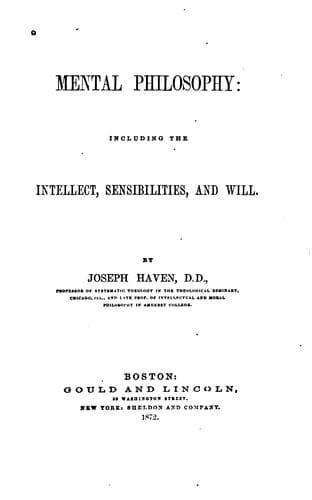
Mental Philosophy: Including the Intellect, Sensibilities, and WillHaven, Joseph
Philosophy
Mental Philosophy: Including the Intellect, Sensibilities, and Will
Haven, Joseph
Psychology
_Inductive Reasoning no Exception._--It may be supposed that the
inductive method of reasoning is an exception to this rule, inasmuch
as we proceed, in that case, not from the general to the particular,
but the reverse. Whatever may be true of deduction, is not induction
essentially a synthetic process? So it might, at first, appear. I have
observed, for example, that several animals of a particular species,
sheep, for instance, chew the cud. Having observed this in several
instances, I presently conclude that the same is true of the whole
class to which these several individuals belong, in other words, that
all sheep are ruminant. Extending my observation further, I find other
species of animals likewise chewing the cud. I observe, moreover,
that every animal, possessing this characteristic, is distinguished
by the circumstance of having horns and cloven hoofs; I find, so far
as my observation goes, the two things always associated, and hence
am led, on observing the one, immediately to infer the other. The
proposition that was at the outset particular, now becomes general,
viz., all animals that have horns and cloven hoofs are ruminant. Is
the conclusion at which I thus arrive, involved in the premiss with
which I start? Is the fact that all horned and cloven-footed animals
are ruminant, implied and contained in the fact that _some_ horned and
cloven-footed animals, that is, so many as I have observed, are so?
_Even here the Evidence of the Conclusion lies in the Premiss._--A
little reflection will convince us that these questions are to be
answered in the affirmative. If the conclusion be itself correct and
true, then it is a truth involved in the previous proposition; for
whatever evidence I have of the truth of my conclusion, that all
animals of this sort are ruminant, is manifestly derived from, and
therefore contained in, the fact that such as I have observed are
so. I have no other evidence in the case supposed. If this evidence
is insufficient, then the conclusion is not established. If it be
sufficient, then the conclusion which it establishes, is derived from
and involved in it.
The argument fully and scientifically stated, runs thus:
A, B, C, animals observed, are ruminant. But A, B, C, represent the
class Z to which they belong.
Therefore, class Z is ruminant.
Admitting now the correctness of my observation in respect to A, B, C,
that they are ruminant, the argument turns entirely upon the second
proposition that A, B, C, represent the class Z, so that what is true
of them in this respect, is true of the whole class. If A, B, C, _do_
represent the class Z, then to say that A, B, C, are ruminant, is to
say that Z is so. The one is contained in the other. If they do _not_,
then the conclusion is itself groundless, and there is no occasion to
inquire in what it is contained, or whether it is contained in any
thing. It is no longer a valid argument and therefore cannot be brought
in evidence that some reasoning is not analytic.
Public-domain text, read in full here on John Shaqi.
Reviews
Reviews
No reviews yet
Be the first to share your thoughts on this work.
Elsewhere in the archive
Join the Discussion
Join the discussion
Sign in to leave a comment or review.
Sign InorCreate an account