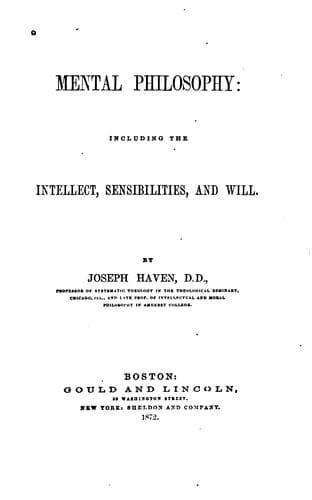
Mental Philosophy: Including the Intellect, Sensibilities, and WillHaven, Joseph
Philosophy
Mental Philosophy: Including the Intellect, Sensibilities, and Will
Haven, Joseph
Psychology
_Conclusion not affirmed in the Premiss._--But while _contained_, it
is not _affirmed_, in the premiss. To say that all men are mortal, is
not to say that Socrates is so, but only to say what implies that.
The conclusion which draws out and affirms what was involved, but not
affirmed, in the premiss, is an advance in the order of thought, a step
of progress, and not merely an idle repetition, and the syllogism, as a
whole, moves the mind onward from the starting-point to a position not
otherwise explicitly and positively reached. It is a movement onward,
and not merely a rotation of the wheel about its own axis.
_The Form accidental._--In so far as the objection of _petitio
principii_ relates, not to the _nature_ of reasoning, but only to its
_form_, this is entirely a matter of accident, and does not pertain to
the syllogism as such. As was shown in treating of the different forms
of syllogism, the order of the propositions is not essential. We may,
if we like, state the conclusion first, and then the reasons, as, All A
is C, for all A is B, and all B is C; or we may state the same thing in
a different form, as, A and B are equal; B and C are equal; therefore,
A and C are equal. Both are syllogisms, the former _analytic_, the
latter _unfigured_, but to neither does the objection of _petitio
principii_ apply so far as regards the mere form of statement. Nor
does it apply to that form of syllogism in which the major premiss is
a singular proposition, as, _e. g._, Cæsar was fortunate; Cæsar was a
tyrant; therefore, a tyrant may be fortunate. Here the subject of the
conclusion is not formally contained in that of the major premiss, as
Socrates is contained in the expression, all men, a part of the whole.
_Objection inapplicable to the inductive Syllogism._--Nor does the
objection apply again to the _inductive_ syllogism, in which the
conclusion is more comprehensive than the premiss. The objection
applies, in fact, only to the deductive syllogism, and to that only in
its synthetic form, and to that only as figured, and as presenting, in
its major premiss, other than a singular proposition.
_Major Premiss, whence derived._--But whence, it may still be asked,
comes the general proposition which every deductive syllogism contains,
whether analytic or synthetic, the proposition _e. g._, that all men
are mortal? Whether this be stated before or after the conclusion is
a mere matter of form; but what is our authority for stating such a
proposition at all? How do we know that which is here affirmed?
Public-domain text, read in full here on John Shaqi.
Reviews
Reviews
No reviews yet
Be the first to share your thoughts on this work.
Elsewhere in the archive
Join the Discussion
Join the discussion
Sign in to leave a comment or review.
Sign InorCreate an account