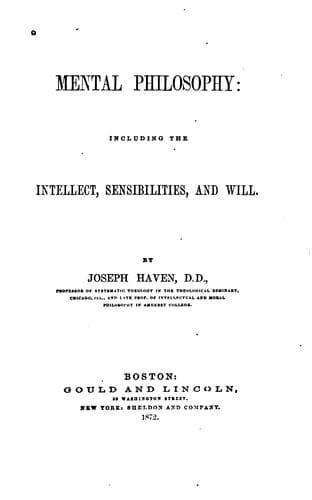
Mental Philosophy: Including the Intellect, Sensibilities, and WillHaven, Joseph
Philosophy
Mental Philosophy: Including the Intellect, Sensibilities, and Will
Haven, Joseph
Psychology
_Introduced into Rome._--For a time the original works of Aristotle
were lost. They lay buried in an obscure retreat whither they had been
carried for safe preservation, and no one knew what they were. Sylla,
capturing the city, brought them to Rome, where they were discovered
to be the works of the great master, and Cicero gives them, with some
labor and learning, to the public. But the Roman mind never mastered
the logic of Aristotle. In all Roman philosophy, says St. Hilaire,
there is scarcely a logician worthy of the name.
For several centuries, if not in Rome, yet in Alexandria and Athens, in
Greece and in Egypt, the logic of Aristotle continued to be assiduously
cultivated.
_Logic in the Middle Ages._--It was in the middle ages, however, that
logic received its chief cultivation and its highest honors. Aristotle
was for some six centuries almost the only teacher of the human mind,
and the Organon was the foundation of his knowledge. Nor during the
irruption of the northern hordes, and the revolutions of society, and
empire, and human manners, which followed, did the philosophy and logic
of Aristotle pass out of sight or out of mind. It seemed impossible
for any revolution of empire or of time to shake its foundations or
break its sceptre over the human mind. In the seventh century, Isidore
of Seville, and Bede the Venerable, gave it their labors and renown.
In the eighth, Alcuin introduced it into the court of Charlemagne. In
the twelfth, Abelard, and the controversy between the Realists and
Nominalists, gave this science still more importance.
_Logic in the Arabian Schools._--Meanwhile, the Mohammedans had been in
advance of the Christians in the study of this science. The Arabs had
inherited the learning of antiquity, and had carried the cultivation
of the peripatetic philosophy to a high degree of perfection more than
a century before it had received the homage of the West. From Arabia it
passed, with the march of conquest, into Spain, and some of the ablest
commentators Europe has produced, on the works of Aristotle, have been
the Moors of Spain.
_Continuance of Aristotle's Dominion._--The Crusades tended only to
enlarge the sphere of this influence. Such men as Albert the Great,
and Thomas Aquinas, became, in the thirteenth century, expounders of
Aristotle. Not till the sixteenth century did this long dominion over
the human mind show symptoms of decadence.
_The Reformers._--Luther, among the Protestant reformers, sought
to banish logic from the schools; but it was retained, and in the
Protestant universities was still professed.
Public-domain text, read in full here on John Shaqi.
Reviews
Reviews
No reviews yet
Be the first to share your thoughts on this work.
Elsewhere in the archive
Join the Discussion
Join the discussion
Sign in to leave a comment or review.
Sign InorCreate an account