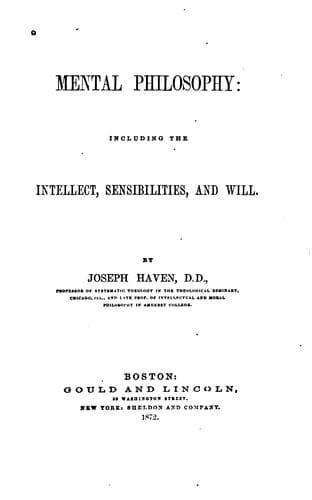
Mental Philosophy: Including the Intellect, Sensibilities, and WillHaven, Joseph
Philosophy
Mental Philosophy: Including the Intellect, Sensibilities, and Will
Haven, Joseph
Psychology
_Correctness of this Enumeration._--That the truths now specified are
in some sense primary, that they are generally admitted and acted
upon, among men, without process of reasoning, and that, when stated,
they command the universal and instant assent of even the untaught and
unreflecting mind, there can be little doubt. Whether, in all cases,
however, they come strictly under the rules and criteria now given;
whether, for example, our own existence and identity are primary
data of consciousness; or whether, on the contrary, they are not
_inferred_ from the existence of those thoughts and feelings of which
we are directly conscious, as, for example, in the famous argument of
Descartes, _Cogito, ergo sum_, may admit of question.
§ II.--INTUITIVE CONCEPTIONS.
Of the results or operations of the faculty under consideration, we
have considered, as yet, only that class which may be designated
as primary _truths_, in distinction from primitive or intuitive
_conceptions_. To this latter class let us now direct our attention.
_Proposed consideration of some of the more important._--Without
undertaking to give a complete list of our original or intuitive
conceptions, there are certain of the more important, which seem
to require specific consideration. Such are the ideas of space,
time, identity, cause, the beautiful, the right--ideas difficult to
define and explain, but, on that account, requiring the more careful
investigation. Let us, then, take up these conceptions one by one, and
inquire more particularly into their nature.
I. _Space._
_Subjective View._--What is space? Is it a mere idea, a mere conception
of the mind, or has it reality? This is a question which has much
perplexed philosophers. Kant and his school regard both time and space
as merely subjective, mere conceptions or forms which the mind imposes
upon outward things, having no reality, save as conceptions, or laws of
thought.
_Opposite View._--On the other hand, if we make space a reality, and
not a mere conception, what is it, and where is it? Not matter, and
yet real, a something which exists, distinct from matter, and yet not
mind. Pressed with these difficulties, some distinguished and acute
writers have resolved time and space into qualities of the one infinite
and absolute Being, the divine mind. Such was the view of Clarke and
Newton, a view favored also by a recent French writer of some note--C.
H. Bernard, Professor of Philosophy in the Lycée Bonaparte.
_A middle Ground._--These must be regarded as, on either hand, extreme
views. But is there a middle ground possible or conceivable? Let us
see. What, then, is the simple idea of space? What mean we by that word?
Public-domain text, read in full here on John Shaqi.
Reviews
Reviews
No reviews yet
Be the first to share your thoughts on this work.
Elsewhere in the archive
Join the Discussion
Join the discussion
Sign in to leave a comment or review.
Sign InorCreate an account