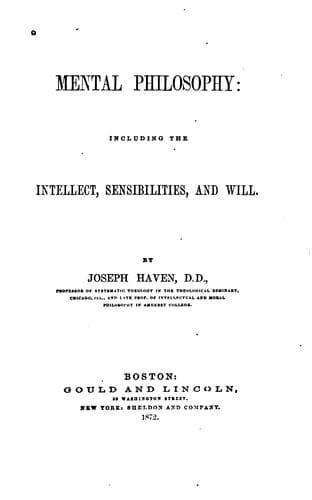
Mental Philosophy: Including the Intellect, Sensibilities, and WillHaven, Joseph
Philosophy
Mental Philosophy: Including the Intellect, Sensibilities, and Will
Haven, Joseph
Psychology
_Locke's Derivation of Cause._--With regard to the origin of the idea
of cause, there has been the greatest diversity of opinion. Locke
derives it from sense; so do the philosophers of the sensationalist
school. We perceive bodies modifying each other, and hence the notion
of causality.
_Theory of Hume and of Brown._--Hume denies the existence of what we
call cause, or power of one object over another. He resolves it into
succession or sequence of objects in regular order, and consequent
association of them in our thoughts. Essentially the same is the theory
of Brown, who resolves cause and effect into simple antecedence and
sequence, beyond which we know nothing, and can affirm nothing.
_Theory of Leibnitz._--The theory of Leibnitz verges upon the opposite
extreme, and assigns the element of power or causal efficiency to every
form of existence; every substance is a force, a cause, in itself.
_Of Kant._--Kant and his school make cause a merely subjective notion,
a law of the understanding, which it impresses upon outward things, a
condition of our thought. We observe external phenomena, and, according
to this law of our intelligence, are under the necessity of arranging
them as cause and effect; but we do not know that, independent of our
conception, there exists in reality any thing corresponding to this
idea. The tendency of this theory, as well as that of Hume and Brown,
to a thorough-going skepticism, is obvious at a glance. The theory of
Maine de Biran has been already noticed.
V. THE IDEA OF THE BEAUTIFUL, AND OF RIGHT.
_These Ideas Intuitive._--- Among the primary ideas awakened in the
mind by the faculty of original or intuitive conception, ideas of
reason, as some writers would prefer to call them, must be included
the notion of the _beautiful_, and also that of _right_--ideas more
important in themselves, and in their bearing on human happiness, than
almost any others which the mind entertains. That these ideas are to
be traced, ultimately, to the originative or intuitive faculty, there
can be little doubt. They are simple and primary ideas. They have
the characteristics of universality and necessity. They are awakened
intuitively and instantaneously in the mind, when the appropriate
occasion is presented by sense. There are certain objects in nature
and art, which, so soon as perceived, strike us as beautiful. There
are certain traits of character and courses of conduct, which, so soon
as observed, strike us as morally right and wrong. The ideas of the
beautiful and the right are thus awakened in the mind on the perception
of the corresponding objects.
_Things to be considered respecting them._--Viewed as notions of the
intuitive faculty, or original conceptions, it would be in place
to consider more particularly the _circumstances_ under which each
of these ideas originates, and the _characteristics_ of each; also
what _constitutes_, in either case, the object, what constitutes the
beautiful and the right.
Public-domain text, read in full here on John Shaqi.
Reviews
Reviews
No reviews yet
Be the first to share your thoughts on this work.
Elsewhere in the archive
Join the Discussion
Join the discussion
Sign in to leave a comment or review.
Sign InorCreate an account