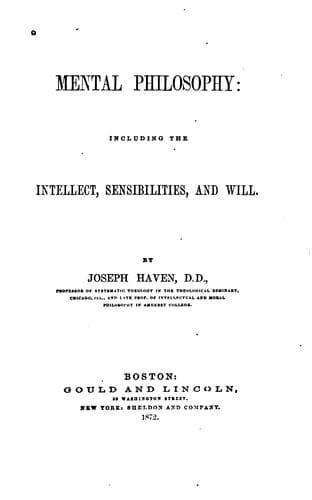
Mental Philosophy: Including the Intellect, Sensibilities, and WillHaven, Joseph
Philosophy
Mental Philosophy: Including the Intellect, Sensibilities, and Will
Haven, Joseph
Psychology
_The Theory applied to inorganic Forms._--And first, to begin with
the lowest, how is it with the inanimate, inorganic, merely chemical
forms of matter? Here we have certain lines, certain figures, certain
colors, that we call beautiful. What do they express of the higher or
spiritual element of being? In themselves, and directly, they express
nothing, perhaps. Yet are they not, after all, suggestive, symbolical
of an idea and spirit dwelling, not in them, but in him who made
them, of the Creator's idea and spirit, inarticulate expressions,
mere natural signs, of a higher principle than dwells in these poor
forms? Do they not suggest and express to us ideas of grace, elegance,
delicacy, and the like? Do we not find ourselves attracted by, and,
in a sort, in sympathy with these forms, as thus significant and
expressive? Is it not thus that lines, and figures, and mathematical
forms, the regular and sharply cut angles of the crystal, the light
that flashes on its polished surface, or lies hid in beautiful color
within it, the order, proportion, and movement, by fixed laws, of the
various forms of matter, appear beautiful to us? For what are order,
proportion, regularity, harmony, and movement, by fixed laws, and what
are elegance, and grace of outline and figure, but so many signs and
expressions of a higher intelligence?
_Theory applied to vegetable Forms._--Passing onward and upward in the
scale of being, taking into view, now, the organic forms of vegetable
life, do we not find a more definite articulate expression of the
spiritual and invisible under the material form? The flower that blooms
in our path, the sturdy tree that throws out its branches against the
sky, or droops pensively, as if weighed down by some hidden sorrow,
address us more directly, speak more intimately to our spirits, than
the mere crystal can do, however elegant its form, or definite its
outline. They express sentiments, not ideas merely. They respond to
the sensibilities, they appeal to the inner life of the soul. They are
strong or weak, timid or bold, joyous or melancholy. It requires no
vigorous exercise of fancy to attribute to them the sensibilities which
they awaken in us. When in lively communion and sympathy with nature,
we can hardly resist the conviction that the emotions which she calls
into play in our own bosoms are, somehow, her own emotions also; that
under these forms so expressive, so full of meaning to us, there lurks
an intelligence, a soul.
Public-domain text, read in full here on John Shaqi.
Reviews
Reviews
No reviews yet
Be the first to share your thoughts on this work.
Elsewhere in the archive
Join the Discussion
Join the discussion
Sign in to leave a comment or review.
Sign InorCreate an account