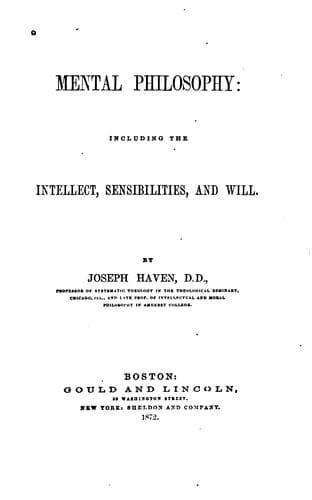
Mental Philosophy: Including the Intellect, Sensibilities, and WillHaven, Joseph
Philosophy
Mental Philosophy: Including the Intellect, Sensibilities, and Will
Haven, Joseph
Psychology
_Reason for distinguishing the two._--As we distinguish, in
philosophical investigation, between an emotion and the intellectual
perception that precedes and gives rise to it, or between the
perception and the sensation on which it is founded, so I would
distinguish _taste_, or the intellectual perception of the beautiful,
from the _sensation_ or _feeling_ awakened in view of the object. The
fact that both elements exist, and enter into the series of mental
phenomena in view of the beautiful, is no reason why they should both
be designated by the same term, or included in the same definition,
but, rather, it is a reason why they should be carefully distinguished.
The precise nature of this faculty may be more distinctly perceived,
if we consider, more particularly, its relation to the _judgment_, and
also to the _sensibility_.
_Taste, as related to Judgment._--According to the view now taken,
taste is only a modification, or rather a particular direction of that
general power of the mind which we call _judgment_; it is judgment
exercised about the beautiful. It is the office of the judgment to
form opinions and beliefs, to inform us of relations, to decide
that things are thus and thus, that this is this, and that is that.
As employed in different departments of thought, it appears under
different forms, and is known under diverse names. As employed about
the actual and sensible, we call it understanding; in the sphere of
abstract truth it works under the cognomen of reason; in the sphere
of practical truth, the thing that is good and right to be done by
me, it is known as conscience; in the sphere of the ideal and the
beautiful it is taste. In all these departments of mental activity
it is exercised, employs itself upon all these subjects, giving us
opinion, belief, knowledge, as to them all. The judgment as thus
exercised in relation to the beautiful, that is to say, the mind
observing, comparing, discriminating, deciding, forming the opinion,
or reaching it may be the positive knowledge that this thing is, or
is not, beautiful--for this is simply what we mean by judgment in any
particular instance--judgment, as thus exercised, is known by the name
of _taste_. More strictly speaking, it is not so much the _exercise_
of the judgment in this particular way in given instances, as the
_foundation_ or _ground_ of that exercise, the _discriminating faculty_
or _power_ of the mind by virtue of which it thus operates.
Public-domain text, read in full here on John Shaqi.
Reviews
Reviews
No reviews yet
Be the first to share your thoughts on this work.
Elsewhere in the archive
Join the Discussion
Join the discussion
Sign in to leave a comment or review.
Sign InorCreate an account