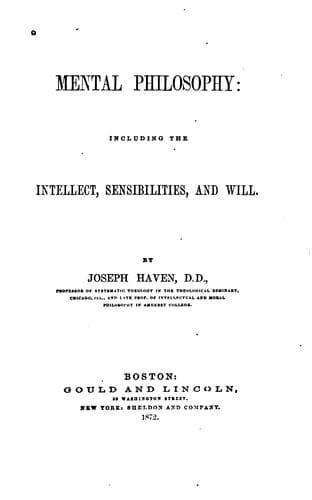
Mental Philosophy: Including the Intellect, Sensibilities, and WillHaven, Joseph
Philosophy
Mental Philosophy: Including the Intellect, Sensibilities, and Will
Haven, Joseph
Psychology
3. _Loss of Control over the Mind._--Analogous to this is the loss of
voluntary control over the mental operations, which is in fact, so far
as the mind is concerned, the essential feature and characteristic
of sleep. Mental action still goes on, there is reason to suppose;
in many cases we know that it does; but the thoughts come and go at
their own pleasure, without regulation or control. It is not in our
power to arrest a certain thought, and fix our minds upon it for the
time, to the exclusion of others, as we can do in the waking moments,
and which constitutes, in fact, the chief control and power we have
over our thoughts, nor can we dismiss, and throw off, an unpleasant
train of thought, a disagreeable impression, however much we may
desire to be rid of it. We are at the mercy of our own thoughts and
casual associations, which, in the ungoverned, spontaneous play of the
mind's own inherent energy, and guided only by its own native laws,
produce the wildest and strangest phantasmagoria, having to us all the
semblance of reality, while we are, in truth, mere passive spectators
of the scene.
_Faculties of Mind not suspended in Sleep._--It has been supposed by
some that the faculties of the mind are, in part or wholly, suspended
in sleep, especially the higher faculties more immediately dependent
on the will. So long as mental activity goes on, however,--and there
is no evidence that it ever entirely ceases in sleep--so long there is
thought, and so long must that thought and activity be exerted in some
particular direction, and on some particular object. We cannot conceive
of the mind as acting or thinking, and not exercising any of its
faculties, for what is a faculty of the mind but its capacity of acting
in this or that way or mode, and on this or that class of subjects.
It may be perception, or conception, or memory, or imagination, or
judgment, or reasoning, or any other faculty that is for the moment
active; it _must_ be some one of the known faculties of the mind,
unless, indeed, we suppose some new faculties to be then developed, of
whose existence we are at other times unconscious.
Public-domain text, read in full here on John Shaqi.
Reviews
Reviews
No reviews yet
Be the first to share your thoughts on this work.
Elsewhere in the archive
Join the Discussion
Join the discussion
Sign in to leave a comment or review.
Sign InorCreate an account