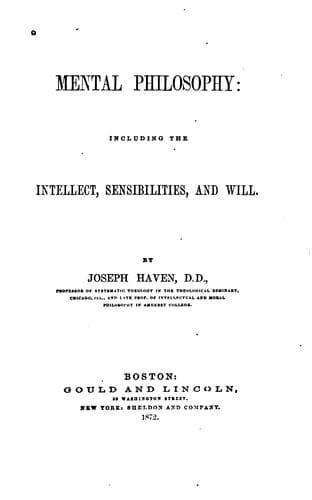
Mental Philosophy: Including the Intellect, Sensibilities, and WillHaven, Joseph
Philosophy
Mental Philosophy: Including the Intellect, Sensibilities, and Will
Haven, Joseph
Psychology
_Mental Faculties not immediately dependent on the Will._--If any of
the mental faculties can be shown to be entirely dependent on the will
for their activity and operation, so as to have no power to act except
by its order or permission, then it would follow that when the will is
no longer in possession of the throne, when its sway is for the time
suspended as in sleep, the faculties thus dependent on it must lie
inactive. But with regard to most if not all mental operations, we know
the reverse to be true. They are capable of _spontaneous_, as well as
voluntary action. Nay, some of them, it would seem, are not subject, in
any case, directly to its control. It is not at our option whether to
remember or forget, whether to perceive surrounding objects, whether
such or such a thought shall, by the laws of association, follow next
in the train of ideas and impressions. Some mental operations are more
closely connected with and admit of a more direct interference on the
part of the will than others, but it cannot be shown, I think, that any
faculty is so far dependent on the will as not to be capable of action,
irrespective of its demands. Indeed, facts seem to show that where once
a train of mental action has been set in operation by the will, that
action goes on, for a time, even when the will is withdrawn, or held in
abeyance, as in sleep, or profound reverie.
_Whence this Suspension of Power of the Will._--The question may occur,
whence arises this suspension of the power of the will over the mental
operations in sleep? What produces it? Does it, like the loss of
voluntary power over the physical frame, result from the inactivity of
the nervous apparatus? The fact that it always accompanies this, and is
found in connection with it, that whatever produces the latter seems
to be the occasion, also, of the former, as in the case of disease,
delirium, mesmeric influence, stupefying drugs, inebriation, etc.,
and that the degree of the one, whether partial or complete, is in
proportion to the degree of the other--these facts seem to me to favor
the idea now suggested.
_Summary of Results._--These, then, seem to be the principal phenomena
of sleep: loss of sensational consciousness, loss of voluntary power
over the body, loss of voluntary power over the operations of the mind.
Public-domain text, read in full here on John Shaqi.
Reviews
Reviews
No reviews yet
Be the first to share your thoughts on this work.
Elsewhere in the archive
Join the Discussion
Join the discussion
Sign in to leave a comment or review.
Sign InorCreate an account