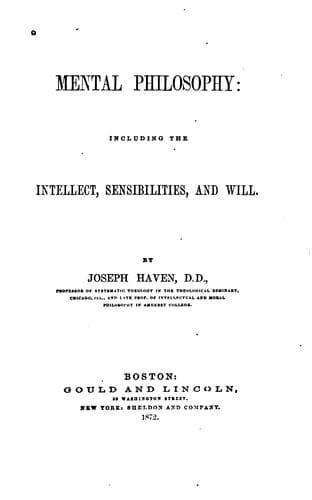
Mental Philosophy: Including the Intellect, Sensibilities, and WillHaven, Joseph
Philosophy
Mental Philosophy: Including the Intellect, Sensibilities, and Will
Haven, Joseph
Psychology
_Power of Suggestion._--In all these forms of delirium now described,
whether artificial or natural, the mind is open to suggestions from
without, and these become often controlling ideas. Hence it is of
imperative necessity that the attendant should be on his guard as to
what he says or does in the presence of the patient. An instance in
point is related by Dr. Carpenter, in which a certain eminent physician
lost a number of his patients in fever by their jumping from the
window, a fact accounted for at once, when we come to hear that he
was stupid enough to caution the attendants, _in the hearing of his
patients_, against the possibility of such an event.
II. _Permanent Forms._--I proceed next to notice those more permanent
forms of mental disorder, commonly termed _insanity_, a term properly
applied to designate those cases of abnormal mental activity in which
there seems to be either some settled disorder of the intellect, as,
_e. g._, when the brain has been weakened by successive attacks of
mania, epilepsy, etc., or else some permanent tendency to disordered
emotional excitement.
_Disorder of the Intellect._--Where the intellectual faculties are
disordered, the chief elementary feature of the case is the same as in
those already noticed, viz., _Loss of voluntary control over the mental
operations_--the psychological ground-work, as we have seen, of all the
various forms of abnormal mental action which have as yet come under
our notice.
_Memory affected._--In the cases now under consideration, the memory
is the faculty that in most cases gives the first signs of failure,
particularly that form of memory which is strictly voluntary, viz.,
recollection. In consequence of this, past experience is placed out of
reach, cannot be made available, and therefore reasoning and judgment
are deficient. The thoughts lose their coherency and connection, as
they are thus cut loose from the fixtures of the past, to which the
laws of association no longer bind them; they come and go with a
strange automatic sort of movement, over which the mind feels that it
has little power. Gradually this little fades away; the will no longer
exercises its former and rightful control over the mental activities;
its sway is broken, its authority gone; the mind loses control of
itself, and, like a vessel broken from her moorings, swings sadly and
hopelessly away into the swift stream of settled insanity. The mind
still retains its full measure of activity, perhaps greatly increased;
but it acts as in a _dream_. All its conceptions are realities to it,
and the actually real world, as it mingles with the dream and shapes
it, is but vaguely and imperfectly apprehended through the confused
media of the mind's own conceptions. All this may be, and often is,
realized, where there is entire absence of all emotional excitement.
Public-domain text, read in full here on John Shaqi.
Reviews
Reviews
No reviews yet
Be the first to share your thoughts on this work.
Elsewhere in the archive
Join the Discussion
Join the discussion
Sign in to leave a comment or review.
Sign InorCreate an account