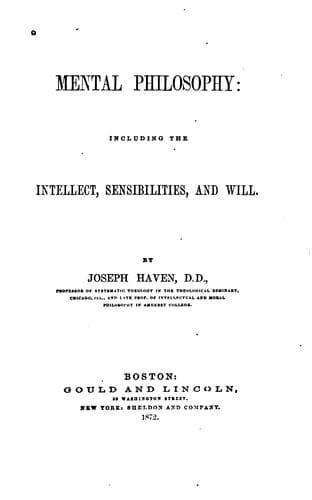
Mental Philosophy: Including the Intellect, Sensibilities, and WillHaven, Joseph
Philosophy
Mental Philosophy: Including the Intellect, Sensibilities, and Will
Haven, Joseph
Psychology
_Difference of the two Departments._--This department of mental
activity differs from the former, as feeling differs from thinking. The
distinction is broad and obvious. No one can mistake it who knows any
thing of his own mental operations. Every one knows the difference,
though not every one may be able to explain it, or tell precisely in
what it consists. But whether able to define our meaning or not, we
are perfectly conscious that to think and to feel are different acts,
and involve entirely different states of mind. The common language of
life recognizes the distinction, alike that of the educated and of the
uneducated, the peasant and the man of science. The literature of the
world recognizes it.
_Relation of the two._--As regards the relation of the two departments
to each other, the intellect properly precedes the sensibility.
The latter implies the former, and depends upon it. There can be
no feeling--I speak, of course, of mental feeling, and not of mere
physical sensation--without previous cognizance of some object, in
view of which the feeling is awakened. Affection always implies an
object of affection, desire, an object of desire; and the object is
first apprehended by the intellect before the emotion is awakened in
the mind. When we love, we love something, when we desire, we desire
something, when we fear, or hope, or hate, there is always some
object, more or less clearly defined, that awakens these feelings,
and in proportion to the clearness and vividness of the intellectual
conception or perception of the object, will be the strength of the
feeling.
_Strength of Feelings as related to Strength of Intellect._--The range
and power of the sensibilities, then, in other words, the mind's
capacity of feeling, depends essentially upon the range and vigor of
the intellectual powers. Within certain limits, the one varies as the
other. The man of strong and vigorous mind is capable of stronger
emotion than the man of dwarfed and puny intellect. Milton, Cromwell,
Napoleon, Webster, surpassed other men, not more in clearness and
strength of intellectual perception, than in energy of feeling. In
this, indeed, lay, in no small degree, the secret of their superior
power. In the most eloquent passages of the great orators of ancient
or modern times, it is not so much the irresistible cogency and
unrelenting grasp of the terrible logic, that holds our attention, and
casts its spell over us, as it is the burning indignation that exposes
the sophistries, and tears to shreds the fallacies of an opponent, and
sweeps all argument and all opposition before it like a devouring
fire. The orations of Demosthenes, of Burke, of Webster, furnish
numerous examples of this.
Public-domain text, read in full here on John Shaqi.
Reviews
Reviews
No reviews yet
Be the first to share your thoughts on this work.
Elsewhere in the archive
Join the Discussion
Join the discussion
Sign in to leave a comment or review.
Sign InorCreate an account