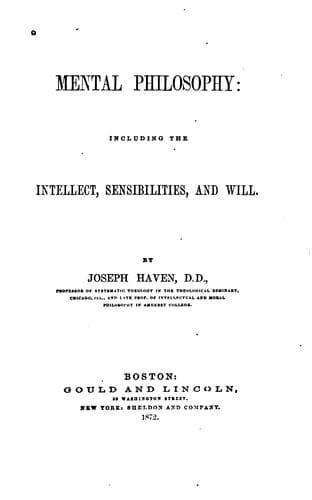
Mental Philosophy: Including the Intellect, Sensibilities, and WillHaven, Joseph
Philosophy
Mental Philosophy: Including the Intellect, Sensibilities, and Will
Haven, Joseph
Psychology
_Not true that we sympathize only with Sorrow._--These reasons
sufficiently account for the almost exclusive attention paid by
moralists to this part of our sympathetic nature, as well as for the
almost exclusive use of the term itself to denote participation in the
sorrows, rather than in the joys of others. It is not necessary to
infer from this circumstance, as some have done, that our sympathies
are only with sorrow, that we do not experience a corresponding emotion
in view of the happiness of others, a view as unfavorable to our nature
as it is remote from truth.
_Distinction of Terms._--Sympathy, as usually employed, to denote a
fellowship with the sufferings of others, is synonymous with the more
specific term _commiseration_, and this again is interchangeable with
the terms pity and compassion. So far as use establishes a difference
between these terms, it is perhaps this: we more frequently employ the
word compassion where there is an ability and a disposition to relieve
the suffering; we pity and we commiserate what it is out of our power
to remedy.
_Strength of this Feeling._--The emotion of sympathy, especially in
that form more specially under consideration, is probably one of the
strongest and most marked in its effects upon the mind, of any of the
feelings of which we are susceptible. When fully aroused, it amounts
even to a passion, When the object that awakens it is exposed to
imminent danger and there is need of instant and efficient exertion
to avert the danger, and bring that relief which, if it comes at
all, must come speedily, then there is no prudent calculation of
consequences, no deliberation, no hesitation, no fear, but, regardless
of every danger, the sympathizer, forgetful of himself, and thinking
only of the object to be accomplished, plunges into the sea or into the
flames, faces the wild beast, or the more savage human foe, seizes the
assassin's arm, or rushes desperately between the murderous weapon and
its victim. This boldness and energy of action are, indeed, the result
of sympathy, rather than the direct exercise of the emotion itself, but
they show how powerful is the feeling from which they spring.
_Irrespective of moral Qualities._--It is worthy of note, moreover,
that the emotion of which we speak, is, in great measure, irrespective
of the moral qualities of the sufferer. He may be a criminal on the
rack or the gallows, the most hardened and abandoned of men, and the
suffering to which he is exposed may be the just punishment of his
crimes, still it is impossible for any one whose heart is not itself
hardened against all human suffering, to regard the miserable victim
with other than feelings of compassion. That must be a hard heart
that could witness the agony of even its worst enemy, in such a case,
without pity for the sufferer.
Public-domain text, read in full here on John Shaqi.
Reviews
Reviews
No reviews yet
Be the first to share your thoughts on this work.
Elsewhere in the archive
Join the Discussion
Join the discussion
Sign in to leave a comment or review.
Sign InorCreate an account