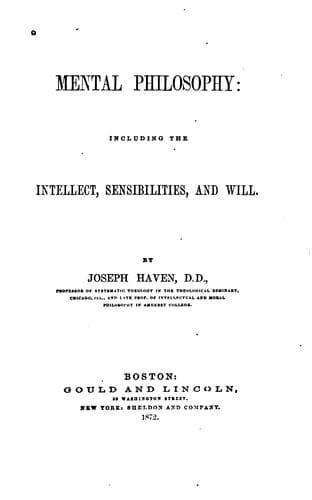
Mental Philosophy: Including the Intellect, Sensibilities, and WillHaven, Joseph
Philosophy
Mental Philosophy: Including the Intellect, Sensibilities, and Will
Haven, Joseph
Psychology
_Of Hobbes._--Hobbes defines laughter, which, so far as relates to the
mind, is merely the expression of the feeling of the ludicrous, to be
"a sudden glory, arising from a sudden conception of some eminency
in ourselves, by comparison with the infirmity of others, or our own
former infirmity." There can be little doubt, I think, that the object
which excites laughter, always present itself to the mind as in some
sense its inferior; and in so far, the definition involves an essential
element of the ludicrous. The person laughing is always, for the time
being, superior, in his own estimation at least, to the person or thing
laughed at. It is some awkwardness, some blunder, some defect of body,
mind, or manner, some lack of sharpness and sense, or of courage, or
of dignity, some perceived incongruity between the true character or
position of the individual and his present circumstances, that excites
our laughter and constitutes the ludicrous.
_Objections to this Theory._--It is not true, however, that the
laughter, or the disposition to laugh, arises from the simple
conception of our own superiority, or the inferiority of the object
contemplated, even in the cases supposed; for if that were so, then
wherever and whenever we discover such superiority, the feeling of
the ludicrous ought to be awakened, and the greater the superiority,
the stronger the tendency to mirth; which is far from being the case.
We are not disposed to laugh at the misfortunes of others, however
superior our own condition may be to theirs in that very respect. My
estate may be better than my neighbor's, or my health superior to
his, but I am not disposed to laugh at him on that account. On the
theory of Hobbes, no persons ought to be so full of merriment, even to
overflowing, as the proud, self-conceited, and supercilious, who are
most deeply impressed with the idea of their own vast superiority to
people and things in general. The fact is precisely the reverse. Such
persons seldom laugh, and when they do, the smile that plays for a
moment on the face is of that cold and disdainful nature which is far
removed from genuine and hearty merriment. It has little in it, as it
has been well said, "of the _full glorying and eminency_ of laughter,"
but is rather like the smile of Cassius.
"He loves no plays,
As thou dost, Antony; he hears no music;
Seldom he smiles; and smiles in such a sort,
As if he mocked himself, and scorned his spirit,
That could be moved to smile at any thing."
We cannot then resolve the ludicrous into the simple perception of some
inferiority of the object or person thus regarded, to ourselves, since
there are many kinds of inferiority which do not, in the least, awaken
the sense of the ludicrous, while, at the same time, those who are most
impressed by the consciousness of their superiority are not usually
most disposed to mirth.
Public-domain text, read in full here on John Shaqi.
Reviews
Reviews
No reviews yet
Be the first to share your thoughts on this work.
Elsewhere in the archive
Join the Discussion
Join the discussion
Sign in to leave a comment or review.
Sign InorCreate an account