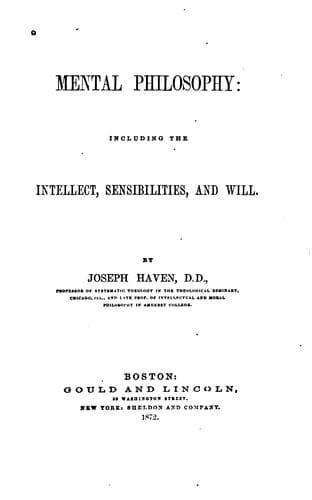
Mental Philosophy: Including the Intellect, Sensibilities, and WillHaven, Joseph
Philosophy
Mental Philosophy: Including the Intellect, Sensibilities, and Will
Haven, Joseph
Psychology
_Novelty as related to Wit._--How much novelty and suddenness add to
the effect of wit, every one knows. A story however witty, once heard,
loses its freshness and zest, and, often repeated, becomes not merely
uninteresting, but irksome, and at length intolerable. In the same
manner, and for the same reason, a witticism which we know to have
been premeditated produces little effect, as compared with the same
thing said in sudden repartee, and on the spur of the moment. That a
man should have studied out some curious relations and combinations of
things in his closet, does not surprise us so much, as that he should
happen to conceive of these relations at the very moment when they
would meet the exigency of the occasion. The epithets which we most
commonly apply to any witty production or facetious remark, indicate
the same thing; we call it lively, fresh, sparkling, full of vivacity
and zest--terms borrowed, perhaps, from the choicer wines, which will
not bear exposure but lose their flavor and life when once brought to
the air.
_Even the Incongruous not always ludicrous._--We come to this result,
then, in our own attempted analysis, that the incongruity of the ideas
or objects brought into relation with each other constitutes the
essential characteristic, the invariable element of the ludicrous, the
effect being always greatly heightened by the surprise we feel at the
novel and unexpected combinations thus presented. It must be remarked,
however, that even the incongruous and unexpected fail to awaken the
sense of the ludicrous, when the object or event contemplated is of
such a nature as to give rise to other and more serious emotions.
When the occurrence, however novel and surprising in itself, or even
ludicrous, is of such a nature as to endanger the life, or seriously
injure the well-being of ourselves or of others, in the one case fear,
in the other compassion, are at once awakened, and all sense of the
ludicrous is completely at an end. The graver passion is at variance
with the lighter, and banishes it from the mind. Should we see a well
dressed and portly man, of some pretension and bearing, accidentally
lose his footing and sprawl ingloriously in the gutter, our first
impulse undoubtedly would be to laugh. The incongruity of his present
position and appearance with his general neatness of person and dignity
of manner would appeal strongly to the sense of the ridiculous. Should
we learn, however, that in the fall he had broken his leg, or otherwise
seriously injured himself, our mirthfulness at once gives place to pity.
Public-domain text, read in full here on John Shaqi.
Reviews
Reviews
No reviews yet
Be the first to share your thoughts on this work.
Elsewhere in the archive
Join the Discussion
Join the discussion
Sign in to leave a comment or review.
Sign InorCreate an account