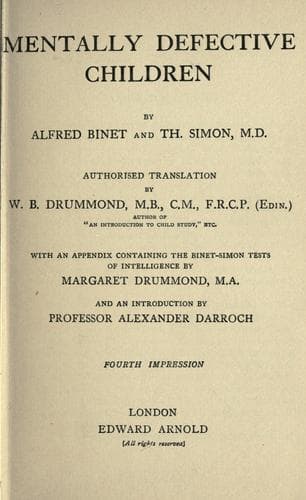
Children with mental disabilities -- Education; Children with mental disabilities -- Psychological testing
It will be remembered that we made a distinction between the
educational and the social return. This distinction is not recognised
by everyone, and many good people take into account only the social
return. There are those who would judge the school of Bicêtre by one
thing only--the number of patients who are made useful to society.
This is a question of great interest, but it is wrong to think that it
is the only one to be considered. It would be unjust to confine
oneself to it. The injustice can be understood by supposing that one
is considering an institution which receives idiots only. Would one
judge such an institution by asking how many of its patients become
capable of winning their livelihood? Certainly not. It is possible to
be of real service to the patients without raising them to such a
level. The cure of dirty habits, for example, is not a thing to be
disdained. Not only does it result in an economy of linen and washing,
but it makes the patient less disgusting, less difficult to take care
of. Here we have material and moral improvement which, even for those
who consider expense only, cannot be considered negligible, for in the
end the result is pecuniary economy. But, having stated this
principle, it would be necessary to find out what is the value, what
is the duration, what is the frequency of such improvements. It would
be necessary to know what is their cost, and to compare the cost with
the results in order to find out where one was. This kind of
stock-taking, both financial and medical, has no place in the
publications of the Bicêtre, and cannot be replaced by isolated
observations on the treatment and improvement of idiot children. There
is here, therefore, a first lacuna. We note also with regret the
absence of any inspection of the teachers in the schools, who are left
to themselves without any supervision but that of the doctor. Now, the
doctor is not usually an educationist, and it is to be regretted that
he does not himself recognise his incompetency in pedagogy, but that,
on the contrary, his nature, often prone to take offence, will not
submit to any collaboration in his work. Having said this, we are
going to confine ourselves to the social return of the school of
Bicêtre, since it is affirmed that such a return exists.
Public-domain text, read in full here on John Shaqi.
Reviews
Reviews
No reviews yet
Be the first to share your thoughts on this work.
Elsewhere in the archive
Join the Discussion
Join the discussion
Sign in to leave a comment or review.
Sign InorCreate an account