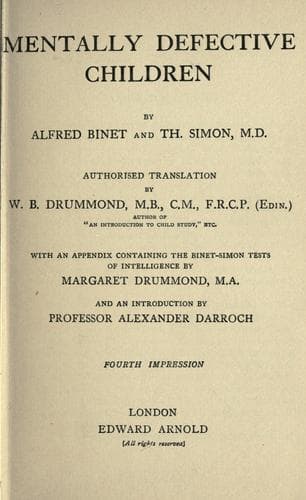
Children with mental disabilities -- Education; Children with mental disabilities -- Psychological testing
for the statistical method to be carried out with greater perfection
to enable us to measure the services rendered by special instruction.
It is probable that the special school would render greater services
than the ordinary school, because it has greater advantages: teachers
experienced in the training of defectives, a curriculum better fitted
to the aptitudes of the latter, and, most important of all, the
possibility of individual instruction.
Let us stop here. In the meantime this is all that we can say with
regard to the organisation and control of special education. If we
were to attempt to go farther we could do so only on _a priori_
grounds. The time has come for experiment. The new classes which are
being formed in Bordeaux, Paris, and elsewhere, must be carefully
watched. We shall grope, we shall make attempts, certainly we shall
commit mistakes, which will not matter very much if only we have the
mind to recognise them and the courage to put them right. The
essential thing is for all the world to understand that empiricism has
had its day, and that methods of scientific precision must be
introduced into all educational work, to carry everywhere good sense
and light.
FOOTNOTES:
[14] In trying to explain this success, one must, no doubt, take into
account the comparatively advanced age of the children, the probable
leniency of the examiners, and, above all, the fact that the
ill-balanced subject is a moral rather than a mental defective.
APPENDIX
[N.B.--Throughout the Appendix Roman numerals refer to
ages--_e.g._, IV. 2 = second test for children of four years.]
Part of the interest of this work on defective children consists in
the fact that in it we find the origin of those ideas and
investigations which culminated in the formation of the Binet-Simon
Scale of Intelligence, now so widely known throughout Europe and
America.
The ideal that Binet set before himself was the formation of a scale
which should measure intelligence in something the same way as the
foot-rule measures height. The first difficulty was the unit. If we
regard intelligence as the power to cope with a situation, we see that
this power in a general way increases with the experience of the
child, or, we may say, with his age. A child of nine should have more
intelligence than one of eight, a child of eight than a child of
seven, and so on. We may suppose, then, that there is a normal
intelligence for each age just as there is a normal height for each
age, although in the first case, as in the second, many children fall
below and many rise above the standard. It is clearly by no means so
easy to establish a norm for intelligence as for height, nevertheless,
the method should be the same; that is, we should begin by finding out
what the intelligence of children of different ages actually is, and
from these results we should derive averages which might be used as
norms.
Public-domain text, read in full here on John Shaqi.
Reviews
Reviews
No reviews yet
Be the first to share your thoughts on this work.
Elsewhere in the archive
Join the Discussion
Join the discussion
Sign in to leave a comment or review.
Sign InorCreate an account