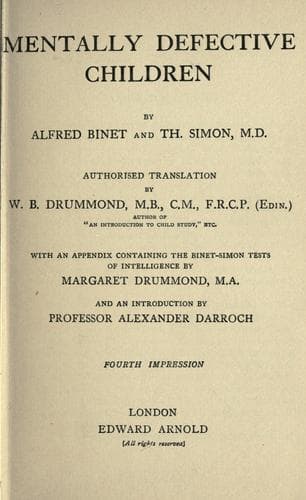
Children with mental disabilities -- Education; Children with mental disabilities -- Psychological testing
4. "You see these lines. Tell me which is longer." See Fig. 7.
No hesitation or uncertainty is satisfactory.
_Five Years._
1. "You see these boxes. Tell me which is heavier."
The examiner places two boxes precisely the same in appearance, but
weighing respectively 3 grammes and 12 grammes, before the child. He
repeats the test with similar boxes, weighing respectively 6 and 15
grammes, and then the first pair is again presented. The boxes should
be arranged so that the heavier one is alternately at the right and at
the left side. Very young children nearly always indicate one of the
boxes by chance without testing them. In this case the examiner is
allowed to say, "You must take the boxes in your hand and weigh them."
2. "Copy this picture for me."
The examiner shows the child a card on which is drawn a square, the
side of which measures an inch and a half. The child is given pen and
ink, an unfamiliar instrument to him at this age. He passes if his
square can be recognised as a square.
3. "Listen to this, and repeat it after me: 'My name is Charlie. Oh!
the naughty dog!'"
Memory of a sentence containing ten syllables is required.
4. "You see these pennies. Now count them with your finger."
Four pennies are placed before the child. They are juxtaposed, but not
superposed. In order to pass, he must count them, touching each with
his forefinger as he says its number. Some little children begin to
count before they touch the first penny; thus they may reach five or
six or even more.
5. "Put these pieces together so as to make them look like this."
The examiner has two oblong cards--postcards do very well--one of
which is cut in two pieces along the diagonal. Before giving the
direction to the child, he places the intact card on the table, and,
nearer the child, the two pieces of the other card arranged so that
the two hypotenuses form a right angle.[A]
_Six Years._
1. "Is it morning or afternoon now?"
As many little children tend simply to repeat the examiner's last
words, it is better to reverse the terms "morning" and "afternoon"
when the examination takes place in the afternoon.
2. "What is a fork?"--What is a table?"--"A chair?"--"A horse?"--A
mamma?"
Three levels of intelligence may be distinguished in the responses.
The lowest is that of silence, or repetition of the term, or
designation by gesture. The second, which should be attained at the
age of six, is that of definition by use, as: "A fork is for eating
with." The third level is attained by the ninth year; the child at
this level attempts to describe the object or to say what it is made
of. The type of the majority of the definitions determines one's
judgment of the level attained.
3. "Copy this picture for me."
The examiner shows the child a card on which is drawn a diamond, of
which the side measures an inch and a half, and the acute angles 60
degrees. The drawing must be done with pen and ink.
4. "Count these pennies."
Public-domain text, read in full here on John Shaqi.
Reviews
Reviews
No reviews yet
Be the first to share your thoughts on this work.
Elsewhere in the archive
Join the Discussion
Join the discussion
Sign in to leave a comment or review.
Sign InorCreate an account