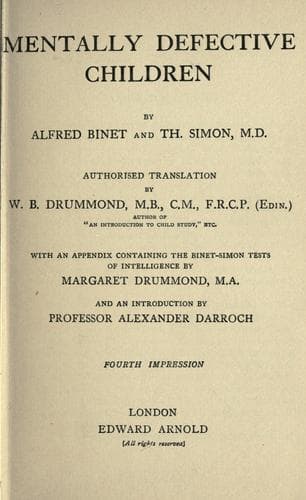
Children with mental disabilities -- Education; Children with mental disabilities -- Psychological testing
5. "Listen to what I am going to read to you. When I have finished I
shall ask you to give me the sense of the passage: 'Many opinions have
been given on the value of life. Some call it good, others call it
bad. It would be more just to say that it is mediocre, for on the one
hand our happiness is never so great as we would have it, and on the
other hand our misfortunes are never so great as others would have
them. It is this mediocrity of life which makes it just, or rather
which prevents it from being radically unjust.'"
=Directions to Examiners.=--In the use of the Binet scale there are
various pitfalls that await the beginner. In the first place he is
almost certain to array himself on the side of the child and to
declare in some instances that the test is not a fair one--the child
could have passed had he understood what was wanted. One frequently
sees this attitude towards the puzzle test. (V. 5.) For example, the
examiner is dissatisfied when the child simply moves the pieces of
card about in a meaningless way, and he tries to explain more clearly
what is wanted. I have seen one examiner go so far as to show the
child the solution, and then give him a pass when he repeated it. The
examiner must always remember that a child who has reached the
required level of intelligence will himself see what is wanted. This
comprehension is indeed the very thing we are testing for.
Secondly, the examiner is apt to show by his manner when he is
dissatisfied with a child's answer. In some cases this may lead him to
correct himself--_e.g._, VII. 1. The examiner must bear constantly in
mind that _all answers are equally pleasing to him_; he is not there
to instruct the child, but to test him. When meaningless or absurd
responses are given, as they frequently are, the examiner must accept
them cheerfully, even in some cases with praise, and record a failure.
The record, of course, must never be visible to the child.
Again, the examiner must not suppose that the scale can be applied
mechanically. Both experience and judgment are necessary before the
results can be correctly gauged. In certain tests--_e.g._, the
absurdities--a child's manner tells as much as his words. The children
on whom I have tried this test nearly always laughed when they really
grasped the point. Before he lays much stress on his results an
examiner should have tested at least twenty children.
Public-domain text, read in full here on John Shaqi.
Reviews
Reviews
No reviews yet
Be the first to share your thoughts on this work.
Elsewhere in the archive
Join the Discussion
Join the discussion
Sign in to leave a comment or review.
Sign InorCreate an account