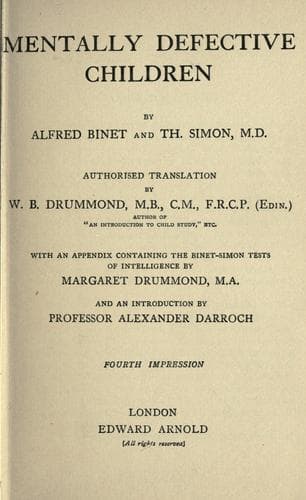
Children with mental disabilities -- Education; Children with mental disabilities -- Psychological testing
Some of the tests (definitions, comparisons, suggestion) bring out a
tendency to automatism which is present in many children. Thus, a
child having replied correctly that a butterfly is bigger than a fly,
may go on to state that wood is bigger than glass, and paper than
cardboard; or having found that "It is a fork" is well received as a
definition of that implement, he may give similar replies to the other
queries in the definition test. This automatism should not be checked:
it should be recorded. The more intelligent children begin to exhibit
a certain dissatisfaction with their own answers, however readily they
are accepted.
It is not always easy to follow the working of the childish mind, and
it is not usually advisable to press for further explanation. Such a
course is apt to puzzle the child, and render the conditions less
favourable. If you are not certain that he should be allowed to pass,
you may be practically certain that he should not. Sometimes one gets
interesting glimpses into the subject's mentality. A little boy once
told me he had never seen a butterfly. Nevertheless, I asked the
comparison question, and he gave what is a very usual answer: "A
butterfly is bigger than a fly." "How do you know," I said, "if you
have never seen a butterfly?" "It's a bigger word," he replied.
Another time a little girl, who also declared she had never seen a
butterfly, gave another answer which is also very common: "A butterfly
is yellow, and a fly is black." The source of this knowledge was not
discovered; but one of my students told me later that a child whom she
questioned about a butterfly said: "I have seen one; it was blue, but
it _ought_ to have been yellow." On being asked why, she responded:
"Butter is yellow." The test, of course, is not for the knowledge of
the things, but for the power of making a comparison. Occasionally one
has to mark a child as doubtful. Thus, in defining abstract terms
(XII. 4) Binet records that out of forty-five nine-year-old children,
four passed, thirty-six failed, and five were doubtful. This test,
however, gives an unusually large percentage of doubtfuls.
Public-domain text, read in full here on John Shaqi.
Reviews
Reviews
No reviews yet
Be the first to share your thoughts on this work.
Elsewhere in the archive
Join the Discussion
Join the discussion
Sign in to leave a comment or review.
Sign InorCreate an account