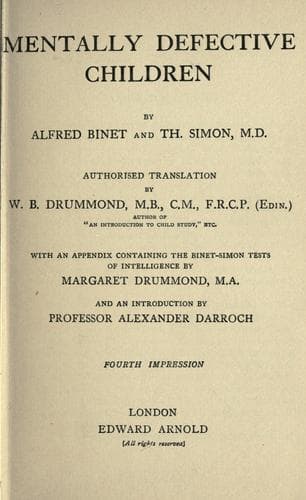
Children with mental disabilities -- Education; Children with mental disabilities -- Psychological testing
Spontaneous writing or writing from dictation must not be confounded
with mere transcription from a copy. The latter is a kind of drawing,
and may be acquired by some who are incapable, from defective
intelligence, of writing from dictation. Nor must real reading be
confused with reading which consists in transforming graphic signs
into sounds without meaning to the reader. The distinction can easily
be made by giving the child in writing some simple order which he is
to carry out, such as "Shut the door," "Knock three times on the
table."
DEFINITION OF A FEEBLE-MINDED CHILD.
_A feeble-minded child is one who can communicate with his kind by
speech or writing, but who shows a retardation of two or three years
(according to the rules already indicated) in his school studies, this
retardation not being due to insufficient or irregular attendance._
These distinctions are pedagogical. The inspector will make them
easily. If he is ever in doubt, he has a doctor at hand who will
advise him.
Obviously the idiot is a case for the asylum or hospice. Obviously
also the feeble-minded is a case for the school. There remains the
imbecile, about whom we may hesitate. From the moment the imbecile
proves himself unable to learn to read or write, his place is in the
workshop. We must find out to what extent he can profit by special
education.
=True and False Defectives.=--We shall formulate a rule which will
surely meet with no objection. It is that _none but defectives should
be admitted to schools for defectives_.
Public-domain text, read in full here on John Shaqi.
Reviews
Reviews
No reviews yet
Be the first to share your thoughts on this work.
Elsewhere in the archive