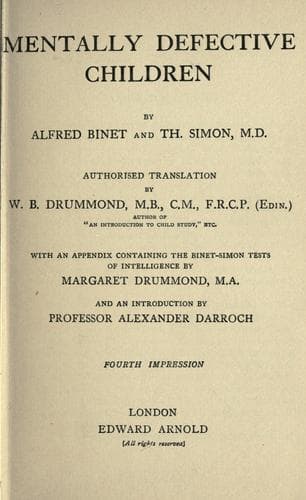
Children with mental disabilities -- Education; Children with mental disabilities -- Psychological testing
The moment we begin to apply this rule in practice, however, we meet
with difficulties. There are normal children who are very backward in
their studies. They cannot profitably follow the proper class for
their age. Such children are numerous, and of great interest
socially. As they are really intelligent they can certainly be helped
to make up for lost time. Various terms have been applied to them, but
it will be simplest to call them "backward" or "ignorant." In Belgium
many such "ignorant" children were admitted to the first school for
defectives. In fact, they formed the majority, and one can understand
how easily the teachers collected them. These are the cases which give
such grand results, and are sometimes exhibited as genuine defectives
who have been improved by teaching. In France it has been agreed that
the ignorant are not to be admitted to the classes for defectives. The
principle is sound. But let us not confuse the questions by
approaching them both at once. Let us consider the defectives first,
the ignorant or backward next. Even when we are agreed as to the
principle, we find difficulties in practice. In the first place, there
are the doubtful cases, children of whom we cannot say, even after
prolonged examination, whether they are defective or backward. Demoor,
in the return he published concerning the pupils of the first school
for defectives at Brussels, noted a considerable number of these
doubtful cases.[12] What should be done with such cases? The best
thing to do is to admit them to the classes for defectives, writing on
their schedule a large mark of interrogation in order to guard against
future deception. Again, it is not always easy to establish irregular
or insufficient attendance when this is the cause of the backwardness.
The child may have been at several schools, and at some the teaching
may have been faulty. There are some schools which practically produce
mediocrity. In the next place, it is necessary to discover the causes
of defective attendance. Sometimes these causes are completely
extrinsic to the nature of the child--frequent removals, constant
domestic disturbances, laxity of the parents, an infirm parent to be
taken care of, etc. In such cases the interpretation presents no
difficulty. But sometimes the case is more embarrassing. It may be a
thin child, who has been out of sorts for a long time. Without being,
properly speaking, of defective intelligence, he is weakly, anæmic,
and consequently incapable of sustained attention. Would it not be
advisable to admit such a case, at least as a temporary measure, into
the class for defectives, until his system had recovered tone? Should
we not also open the door to cases retarded by adenoids? And if we
enter upon this work of charity, shall we not also accept some of
those physically abnormal children who, affected by Little's disease
or Pott's disease, are so little at their ease among their more robust
Public-domain text, read in full here on John Shaqi.
Reviews
Reviews
No reviews yet
Be the first to share your thoughts on this work.
Elsewhere in the archive
Join the Discussion
Join the discussion
Sign in to leave a comment or review.
Sign InorCreate an account