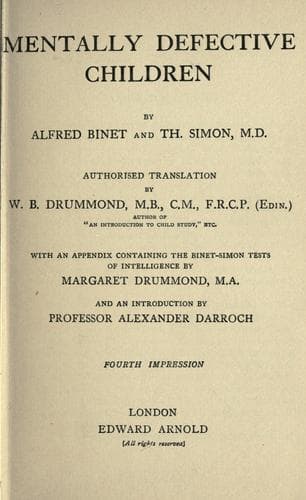
Children with mental disabilities -- Education; Children with mental disabilities -- Psychological testing
_Fourth._--The direct examination of the child bears specially upon
his state of instruction and degree of intelligence. The inspector
comes to a positive decision with regard to each child, and asks the
opinion of the doctor, as well as of the head of the special school,
who assists.
_Fifth._--The inspector has a schedule of particulars regarding the
children finally accepted for the special school filled up by their
teachers in the schools from which they came.
The medical examination will be considered in the next chapter.
Let us add, in conclusion, that all the decisions arrived at are to be
regarded as provisional; the children are to be admitted to the class
for defectives on trial, to be kept under observation.
FOOTNOTES:
[6] See _Année Psychologique_, vol. xii., p. 1, and vol. x., p. 116.
The method sometimes adopted, for other purposes, of asking the
teacher to classify the children according to their intelligence is
quite fallacious. Teachers make no allowance for age. Recently an
excellent teacher pointed out to us, as the most intelligent in the
class, a child who had really, when his age was taken into account, a
retardation of two years; but in a class of younger children his age
gave him an appearance of mental superiority. [Such facts vitiate much
statistical work on the correlation of "brightness" in school-children
with other qualities.--TR.]
[7] Teachers have a troublesome habit of saying simply "attendance
regular" or "irregular." The inspector should demand an exact return
of the absences.
[8] There are two methods of stating the representative value of a
group, the _average_ and the _median_. Everyone knows the average. The
median is obtained by arranging the values in linear series from the
smallest to the greatest and taking the middle one. When should one
use the average, and when the median? It is not easy to give a general
rule, but in this case of spelling, we have a good example. If we wish
to calculate the number of mistakes for each age, to take the average
might be a disastrous proceeding. A single child who made a hundred or
so mistakes would obviously make the average unfairly high. The median
is affected much less by such aberrant cases, and consequently is more
suitable for very heterogeneous series, in which the difference
between the maximum and the minimum is very great.
[9] By way of comparison, the following dictation was given to
ninety-two children in an Edinburgh school. The progressive
difficulties depend upon the non-phonetic spelling and the lesser
familiarity of words. Most of the children came to school in their
sixth year.
1. Tom is a good boy. He has a book and a bat. He can run fast.
2. The dog is bigger than the cat, but he cannot climb so well. He
would if he could.
3. The farmer walked through the wood till he came to the field. It
was a fine day for sowing the corn. He hoped it would not rain till he
had finished his work.
Public-domain text, read in full here on John Shaqi.
Reviews
Reviews
No reviews yet
Be the first to share your thoughts on this work.
Elsewhere in the archive
Join the Discussion
Join the discussion
Sign in to leave a comment or review.
Sign InorCreate an account