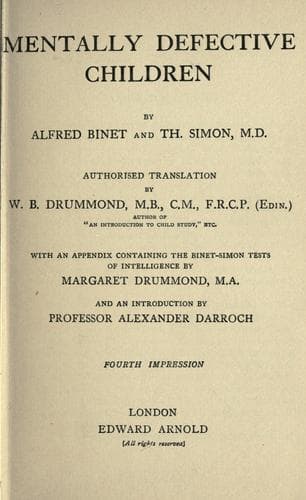
Children with mental disabilities -- Education; Children with mental disabilities -- Psychological testing
It seems to us that the field is sufficiently great for everyone to
glean, and the efforts of all will not be too great to clear it. There
are some questions which escape the doctor, unless he is also an
educationist and a psychologist. But there are also some, in our
opinion, for which he has special competence, and where no one can
take his place. To define his rôle is not to lessen it; on the
contrary, it is to assure him an authoritative position. It is not his
business to select the abnormal from the normal. But from the children
picked out as abnormal he will differentiate certain types and
prescribe certain measures with regard to their care and treatment.
THE DOCTOR NOT TO PICK OUT THE DETECTIVES FROM AMONGST THE CHILDREN IN
SCHOOL.
There is a general misunderstanding with regard to the special
knowledge and aptitude of the doctor. One tends to credit him with a
kind of omnipotence and infallibility against which he protests in
vain. He is made to judge questions which do not belong to his special
province--namely, the medical, and upon which he expresses opinions
which are neither more nor less valuable than those of any other
intelligent person. Recently, at various congresses, we have seen
doctors with the best intentions laying down educational programmes,
comparing the educative value of science with that of letters, and
expressing a variety of opinions, no doubt very sensible, but with
which the medical art had nothing whatever to do. As regards the
selection of defectives, one is influenced by the same prejudice. We
have discussed this with many people, and especially with
educationists, and when we have insisted on the difficulties of
examination, they usually reply, "That is the doctor's business!" The
prejudice we have noted is very tenacious, and will doubtless be
difficult to overcome, for there are many people who have interests to
maintain of a pecuniary nature. Let us consider this question from two
points of view--the estimation of educational retardation, and the
physical examination of defectives.
Public-domain text, read in full here on John Shaqi.
Reviews
Reviews
No reviews yet
Be the first to share your thoughts on this work.
Elsewhere in the archive
Join the Discussion
Join the discussion
Sign in to leave a comment or review.
Sign InorCreate an account