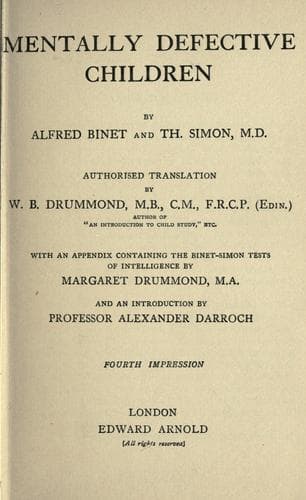
Children with mental disabilities -- Education; Children with mental disabilities -- Psychological testing
But what help could their study render us in the question whether a
particular child ought or ought not to be admitted into a class for
defectives? There is an opinion which is very widespread, especially
amongst teachers and ordinary people, a souvenir of the doctrines of
Gall, that the physical stigmata are signs of the original character,
and that the possessor of a certain shape of head is certainly
defective. "I have taken my son," a worthy mother said to us, "to
consult Dr. P., because he was learning nothing in his class. He was
sent away from every school I sent him to, and he is unbearable at
home. The doctor felt all over his head. He evidently saw that there
was something particular wrong with the boy." We do not smile at this
good mother. Plenty of other intelligent people hold her opinions, if
they are not so naïve in their language. They expect that the moment
defective children are brought before them, they will find something
peculiar, something ugly, in their physiognomy. And there are plenty
of doctors, let us say frankly, who are equally naïve, and, more
serious still, allow themselves to be influenced by unconscious
suggestions. If, like our worthy mother, we present to the doctor a
child as defective, the doctor will, as a general rule, have no
difficulty in demonstrating that he must be so. How many of us are
there without stigmata? None of us is built upon the model of the
ideal man. It is always possible to discover some anatomical detail
which will give support to a preconceived opinion. But the same doctor
who, on seeing a defective child with adherent ear lobes, will say
that that was just what he expected, will abruptly change his opinion
if he discovers a whorl of frontal hair on a child who is presented to
him as normal, and will refuse to attach to the fact any importance
whatever. As a matter of fact, these questions have not yet been
studied as they ought to be, by a comparison without _parti pris_
between normal and abnormal children of the same age and in the same
environment, and we do not yet know how stigmata should be
interpreted. We can only suggest some provisional conclusions.
The first of these conclusions is that the presence or absence of a
definite stigma has no exact significance for the individual who bears
it; for on the one hand one meets with all kinds of malformations in
average normal children, and on the other hand, some who are
definitely abnormal are quite normal in their conformation. The
stigma, therefore, has not the value of a definitely pathognomonic
sign like the crepitating râle of pneumonia, or the transient
unconsciousness of epilepsy; but if we compare a group of normal
children with a group of abnormal, the total number of the stigmata
will be much greater in the second group; and, moreover, the
multiplicity of stigmata in a single individual constitutes a strong
probability that that individual is abnormal. Here are some facts
which support these two propositions:
Public-domain text, read in full here on John Shaqi.
Reviews
Reviews
No reviews yet
Be the first to share your thoughts on this work.
Elsewhere in the archive
Join the Discussion
Join the discussion
Sign in to leave a comment or review.
Sign InorCreate an account