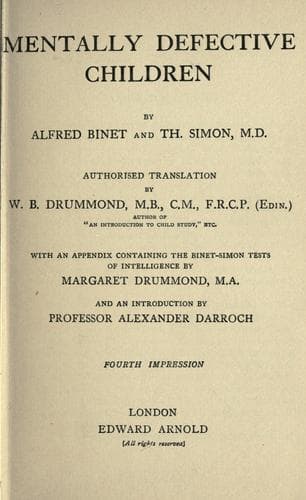
Children with mental disabilities -- Education; Children with mental disabilities -- Psychological testing
We shall, however, say a few words about another
infirmity--incontinence of urine. If there is presented for a class
for defectives a subject, eleven years of age, who cannot control
himself in this respect, the course to follow is: submit the child to
examination by a specialist, who will decide the nature of the
incontinence. If it is curable, give the condition the necessary
attention, or give instructions at the school for training the child
properly; but if there is an incurable weakness of the sphincters,
supply the child with the same kind of apparatus as is used in such
cases by ordinary people.
* * * * *
Here, then, are a number of important points upon which the doctor may
be called to give his opinion. It is he alone who is able, by his
special knowledge, to enlighten the other members of the jury. If the
mental condition is doubtful and requires further observation, it is
for him to point it out. One will thus avoid the mistake of placing in
a class for defectives a lunatic, or a child poisoned by alcohol, who
would not find there the kind of care required. If the bodily
condition discovered complicates or aggravates the mental deficiency,
as adenoid vegetations may do, he will prescribe the proper treatment.
If he suspects the coexistence of some neurosis, he will give
directions by which the condition may be recognised, and consequently
treated. The doctor therefore has to recognise the physical and mental
ailments by which the defective may be affected. He makes this
diagnosis for two reasons. In the first place, in order that mental
deficiency may not be confounded with conditions of illness of a
different kind; and, secondly, in order to relieve or cure if possible
coexisting affections which may aggravate the condition of the
children and interfere with the work of the school.
* * * * *
We shall conclude here what we have to say about the rôle of the
doctor, since in this volume we are specially concerned with the
recognition and segregation of the children. To discuss the rôle of
the doctor quite fully would take us too far.
The details we have given show that the part of the doctor with regard
to defectives is quite different from that of the teacher. It is not
so much to determine the child's precise mental level as to diagnose
the condition of his brain, and to discover, by analysis of all the
symptoms, the original responsible agent. That, however, is the second
part of the doctor's work, and is of scientific interest; whereas the
first part, which consists in diagnosing the ailments which co-exist
with the mental deficiency, is of immediate practical utility.
Public-domain text, read in full here on John Shaqi.
Reviews
Reviews
No reviews yet
Be the first to share your thoughts on this work.
Elsewhere in the archive
Join the Discussion
Join the discussion
Sign in to leave a comment or review.
Sign InorCreate an account