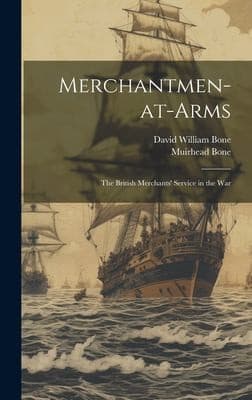
Merchantmen-at-arms : the British merchants' service in the warBone, David W. (David William)
History
Merchantmen-at-arms : the British merchants' service in the war
Bone, David W. (David William)
Merchant marine -- Great Britain; World War, 1914-1918 -- Naval operations
Hesitating and slipshod and inexact as we were, at least we made, of our
own volition, a start; a start that might, under proper and specialized
direction, have made an efficient and accurate addition to the sum of
our sea-lore. But we were wedded to titbits. Late on the tide, as
usual, the Board of Trade woke up to what was going on. They added a
'piece' to our lessons, without thought or worry as to the provision of
facilities for right instruction. We crammed hard for a few days, fired
our shot at the right moment, and forgot all about it.
[Illustration: THE BRIDGE-BOY REPAIRING FLAGS]
Withal, in our own amending way, we were enthusiastic. We learned the
trick of _Ak_ and _Beer_ and _Tok_ and _Pip_. We slapped messages at one
another (in the dog-watches), in many of which a guess was as good a
translation as any. Our efforts received tolerating and amused
recognition from naval officers (secure in possession of scores of
highly trained signal ratings). If we came, by chance, across an affable
British warship, she would perhaps masthead an E (exercise), to show
that there was no ill-feeling. Then was the time to turn out our star
man, usually the junior-est officer, and set him up to show that we were
not such duffers, after all! Alas! The handicaps that came against us!
The muddled backgrounds (camouflage, as ever was!), the fatal
backthought to a guess at the last word! The call and interfering
counter-call from reader to writer, and writer to reader, and, finally,
the sad admission--an inevitable _Eye_, _emmer_, _eye_ (I.M.I.--please
repeat), when our scrawl and jumble of conjectural letters would not
make sense! We have yet a mortifying memory of such an incident, in
which a distant signalman spelt out to us, clearly and distinctly, "_Do
you speak English?_"
Under the stress of war we have improved. Fear for the loss of important
information has spurred us to keener appreciation. If you promise not to
flirt the flags backhanded (a most damnably annoying habit of superior,
_flic-flac_ Navy men) we can read you in at ten or twelve words a
minute. For single-ship work, that was good enough; if we had a press of
signalling to attend, we could make up for our busy time in leisurely
intervals. But convoy altered that. In the Naval Service a signalman
has nothing whatever to do in the wide world but attend to signals. It
is his only job: a highly trained speciality. With us the demands of
ship work on our bare minimum crews do not allow of a duty signaller; he
must bear a hand with the rest to straighten out the day's work. In
convoy, with signals flying around like crows at the harvest, we found
our way of it unworkable. It resolved itself to what used to be called a
'grand rally' in pantomime--all hands on the job, and the officer of the
watch neglecting a keen look-out to see that note of the message was
kept properly.
Public-domain text, read in full here on John Shaqi.
Reviews
Reviews
No reviews yet
Be the first to share your thoughts on this work.
Elsewhere in the archive
Join the Discussion
Join the discussion
Sign in to leave a comment or review.
Sign InorCreate an account