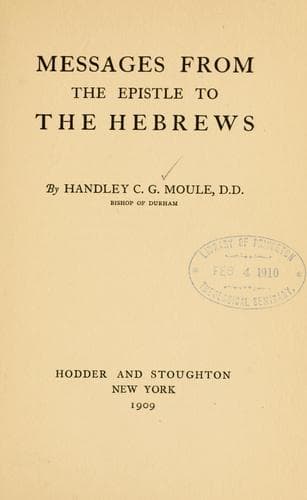
Messages from the Epistle to the HebrewsMoule, H. C. G. (Handley Carr Glyn)
Religion
Messages from the Epistle to the Hebrews
Moule, H. C. G. (Handley Carr Glyn)
Bible. Hebrews -- Commentaries
Here is one of the greatest, if not the greatest, of the benedictory
prayers of the Bible. At every turn it sets before us truths of the
first order, woven into one wonderful texture. It presents to us our God
as "the God of peace," the God who has welcomed us to reconciliation and
is now and for ever reconciled; at peace with us and we with Him. It
sets full in view the supreme fact upon which that certainty reposes,
the Resurrection of His Christ, recorded here and only here in the long
Epistle, as the act and deed by which the Father sealed before the
universe His acceptance of the Son for us. It connects that Resurrection
with its mighty antecedent, the atoning Death, in words pregnant with
the truths characteristic of the Epistle; the Lord, the great Shepherd,
was "brought again from the dead" (the phrase is reminiscent of Isa.
lxiii. 11, with its memories of Moses and the ascent of Israel from the
parted waters), "in the blood" (as it were attended, authenticated,
entitled, by the blood) "of covenant eternal," that supreme Compact of
Divine love of which twice over (chapters viii., x.) the Epistle has
spoken; under which, for the slain Mediator's sake, God both forgives
iniquity and transfigures the will of the forgiven. Then the prayer
follows upon these mighty premisses. The Teacher asks, with the
authority of an inspired benediction, that this God of peace, of
covenant, of the crucified and risen Lord Jesus, would carry out the
covenant-promise in His new Israel to the full. May He "perfect" them,
that is to say, equip them on every side with every requisite of grace,
for the supreme purpose of their existence, the doing of His will in
everything. May He so inhabit and inform them, through His Son, by His
Spirit, that He shall be the will within their will, the force beneath
their weakness, "working in them to will and to do for His good
pleasure's sake" (Phil. ii. 13). To Him, the Father, be glory for ever.
To Him, the Son, be glory for ever. Who shall decide, and who need
decide, to which Divine Person the relative pronoun [Greek: ho]
precisely attaches? The glory is to the Father in the Son, to the Son in
the Father.
Public-domain text, read in full here on John Shaqi.
Reviews
Reviews
No reviews yet
Be the first to share your thoughts on this work.
Elsewhere in the archive
Join the Discussion
Join the discussion
Sign in to leave a comment or review.
Sign InorCreate an account