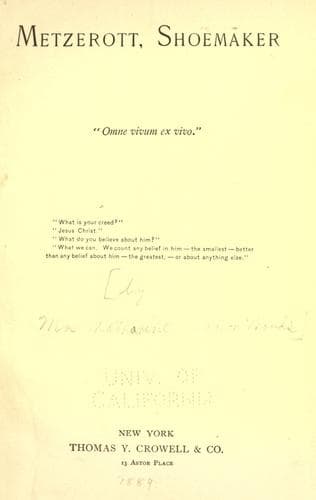
Christian socialism -- Fiction; German Americans -- Fiction; Shoemakers -- Fiction
The winter which had just ended had been unusually mild; very little
snow had fallen, even in the hills; but the months of April and May had
been marked by an unusual rainfall, and the Mickle River, though not
over its banks, stood at a height which, earlier in the year, would have
been decidedly alarming, but which was viewed at this season with
complacency as an excellent preparation for the summer droughts.
Ascension Day fell this year near the end of May, and the three Rogation
days preceding it were, as usual, employed as days of prayer for
spiritual but especially for temporal blessings. In some of the churches
constant intercession was carried on from six in the morning to nine at
night, but of these St. Andrew’s was not one.
“I fear I shall never be able to put much heart into a petition for
earthly blessings,” said the rector to Ernest Clare, “though I would not
say so publicly; and, of course, it is quite right to ask God’s blessing
on the fruits of the earth,” he added apologetically; “but to me ‘Thy
Will be done’ includes everything.”
“‘Give us this day our daily bread,’” returned the other gravely.
“Yes, yes, I know; we have the best authority for it, I don’t deny that;
but it seems to me more childlike just to trust God for things of earth,
and spend one’s time in prayer for things of heaven.”
“‘Thy Will be done _on earth_,’” replied the younger clergyman, “and His
will is—as He has told us—to clothe and feed us, as He clothes the grass
of the field and feeds the sparrows. And that will shall be done one
day.”
“Ah! there you are with your Communism,” said the rector. “Well, it’s
only a matter of feeling, and, I dare say, I’m wrong about it.”
“I wish we all had your faith, sir,” said Mr. Clare; “but don’t you
think one sometimes learns to pray by needing to pray for bread? Then,
afterwards, one can pray for the Bread of Heaven.”
“There is no doubt about that,” said the rector.
Ascension Day brought another heavy rainstorm to swell the Mickle
River,—a storm which increased, with the accompaniment of furious winds,
during the night, and on Friday. About the middle of the afternoon Mr.
Clare, who, in his capacity of carpenter, had gone up-town to attend to
a job, was passing a telegraph office on his way home, when he heard his
name called loudly and anxiously; and, turning round, saw a young
operator, well known to him and us, by the name of Heinz Rolf, with his
body half out of the window, beckoning wildly.
“Good God, Mr. Clare! the most horrible disaster!” he gasped, as the
clergyman obeyed the summons. “The dam—the Cannomore Dam—has burst;
forty feet of water rushing down the Cannomore Valley—thirty thousand
people in the water _now_—and”—he paused with his eyes on Mr. Clare’s.
The Irish mind is not, like the German, fundamentally geographical; and
for a moment the clergyman did not entirely grasp the situation.
Public-domain text, read in full here on John Shaqi.
Reviews
Reviews
No reviews yet
Be the first to share your thoughts on this work.
Elsewhere in the archive
Join the Discussion
Join the discussion
Sign in to leave a comment or review.
Sign InorCreate an account