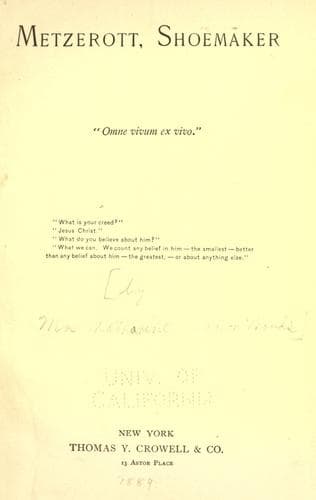
Christian socialism -- Fiction; German Americans -- Fiction; Shoemakers -- Fiction
“Ah! he’s a fine lad, Bruno! but is it Turks ye say? Thank the pigs,
we’re not troubled with the likes of them. Nor the Jews don’t take
kindly to us either; but I’ll show you the grandfather of all the
infidels presently, so ye’ve good luck.”
He opened as he spoke a large double swing door, which led into a
dining-hall, well lit and ventilated, where, at various-sized tables,
about two hundred persons could be accommodated. Only about half of
these tables, however, were laid for dinner, for which Father McClosky
proceeded to account.
“Ye see,” he said, “it’s only them that lives in the house, or works
near by, that can spare the time to go and come. Teachers at a distance,
or hands in the mills or the pottery, mostly has their dinner sent. I’ll
show ye the wagon starting, in five minutes from now. Then, the mothers
of families where there’s many little children finds it more convenient
to take their dinners at home, too, though most of them come for supper,
even the babies.”
“It must be a pretty sight,” said Ernest Clare.
Father McClosky shrugged his shoulders. “It’s Bedlam broke loose,” he
said; “but sure they enjoy it, and them that don’t can stay at home.
It’s a free country, and no man has a better right at ‘Prices’ than any
other.”
“And which costs more—for that is the grand criterion nowadays—to eat
here, or have one’s meals sent?”
“Both, and nayther,” replied the priest, “the charge is exactly the
same; but of course there’s more wear and tear of property in sending.
But, as that comes out of the pockets of the stockholders, it is not
supposed that they will incur the loss without necessity.”
“Then all the patrons are stockholders?”
“They must be, to the extent, at least, of one share, which is five
dollars. The directors found it necessary to pass a by-law to that
intent, or else, as they said, just put up with regular boarding-house
grumbles. Now, every one has an interest in saving, and them that can,
help with the work. That saves hired labor, and makes the dividends
larger.”
“Then you do pay dividends to your stockholders? I thought it was only
to the workers, and that stockholders were to receive merely a fair
interest on their investment.”
“We’ve two classes of stockholders,” said Father McClosky. “Those who
are also patrons, and those who are not. The last named get five per
cent on every dollar as promptly as pay-day comes; but the others, since
they have a hand in the work,—or a tooth in it, annyhow,—we consider
entitled to a share in the profits. We find it’s a good working
principle. I’ve a hundred dollars in it meself, that paid me—interest
and dividend—about the likes of seven dollars, last year, and sure it’s
a great joy to me now when a fast day comes round.”
“So you take self-interest as the moving spring of your work?”
Public-domain text, read in full here on John Shaqi.
Reviews
Reviews
No reviews yet
Be the first to share your thoughts on this work.
Elsewhere in the archive
Join the Discussion
Join the discussion
Sign in to leave a comment or review.
Sign InorCreate an account