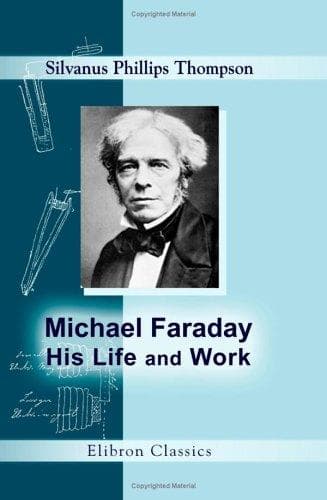
Between Faraday and the scientific men of his time there subsisted
many various relations. The influence which he exerted as a lecturer
and as an experimental investigator was unique; but, apart from
such influences, those relations were mainly confined to individual
friendships. With the organisation of science he had relatively very
little to do. We have seen how highly he prized the honour of admission
to the Fellowship of the Royal Society; and it remains to be told of
the gratification with which he accepted the scientific honours which
he received from almost every academy and university in Europe. Yet
he took little part in the work of scientific societies as such. Four
years after his election as F.R.S. he served on the Council, and he
remained on till 1831. He served again in 1833 and 1835. He was not,
however, satisfied with the management of the Royal Society, nor with
the way in which its Fellowship was at that time bestowed on men who
had no real claims on science, but were nominated through influence.
Echoes of this discontent are to be found in various pamphlets of the
day by Moll, Babbage, South, and others. Faraday, who edited Moll’s
pamphlet on the “Decline of Science,” is believed to have had an even
larger share in its production. In 1830 the really scientific men
amongst the Fellows desired to place Sir John Herschel as President;
the less scientific preferred the Duke of Sussex. Faraday took the
unusual step of speaking on the question, advocating the principle
that eminence in science should be the sole qualification for the
Presidency. At the same meeting Herschel moved, and Faraday seconded,
a plan for reforming the Council by nominating a list of fifty Fellows
from whose number the Council should be chosen. They carried their
plan, and Faraday’s name was amongst those so selected to serve. But
the presidential election went in favour of the Duke of Sussex by 119
to 110 votes. After 1835 Faraday never served again on the Council. In
1843 he wrote to Matteucci:--
I think you are aware that I have not attended at the Royal
Society, either meetings or council, for some years. Ill health
is one reason, and another that I do not like the present
constitution of it, and want to restrict it to scientific men.
As these my opinions are not acceptable, I have withdrawn from
any management in it (still sending scientific communications
if I discover anything I think worthy). This, of course,
deprives me of power there.
[Sidenote: REFORM IN THE ROYAL SOCIETY.]
Two months earlier he wrote to Grove, who at that time was carrying out
the long-needed reforms, sympathising, but declining to co-operate:--
Royal Institution,
December 21, 1842.
Public-domain text, read in full here on John Shaqi.
Reviews
Reviews
No reviews yet
Be the first to share your thoughts on this work.
Elsewhere in the archive
Join the Discussion
Join the discussion
Sign in to leave a comment or review.
Sign InorCreate an account