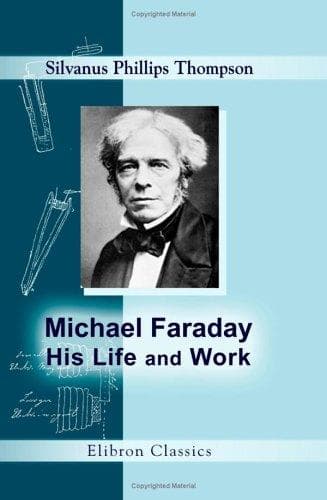
Faraday, with his curved lines of electric force, and
his dielectric efficiency of air and of liquid and solid
insulators, resuscitated the idea of a medium through which,
and not only through which but _by_ which, forces of attraction
or repulsion, seemingly acting at a distance, are transmitted.
The long struggle of the first half of the eighteenth century
was not merely on the question of a medium to serve for
gravific mechanism, but on the correctness of the Newtonian
law of gravitation as a matter of fact, however explained. The
corresponding controversy in the nineteenth century was very
short, and it soon became obvious that Faraday’s idea of the
transmission of electric force by a medium not only did not
violate Coulomb’s law of relation between force and distance,
but that, if real, it must give a thorough explanation of that
law. Nevertheless, after Faraday’s discovery of the different
specific inductive capacities of different insulators, twenty
years passed before it was generally accepted in Continental
Europe. But before his death, in 1867, he had succeeded in
inspiring the rising generation of the scientific world
with something approaching to faith that electric force is
transmitted by a medium called ether, of which, as had been
believed by the whole scientific world for forty years, light
and radiant heat are transverse vibrations. Faraday himself
did not rest with this theory of electricity alone. The very
last time I saw him at work at the Royal Institution was in
an underground cellar, which he had chosen for freedom from
disturbance, and he was arranging experiments to test the
time of propagation of magnetic force from an electromagnet
through a distance of many yards of air to a fine steel needle,
polished to reflect light; but no result came from those
experiments. About the same time, or soon after, certainly not
long before the end of his working time, he was engaged (I
believe at the Shot Tower, near Waterloo Bridge, on the Surrey
side) in efforts to discover relations between gravity and
magnetism, which also led to no result.
[Sidenote: KELVIN’S APPRECIATION.]
Lord Kelvin, who was himself the first to perceive that Faraday’s ideas
were not inconsistent with mathematical expression, and to direct Clerk
Maxwell and others to this view, had, in 1854, delighted the old man
by bringing mathematical support to the conception of lines of force.
In 1857 he sent to Faraday a copy of one of his papers, and received
in acknowledgment a letter of warm encouragement, which, however, does
not appear to have been preserved. Lord Kelvin’s reply is its own best
commentary:--
Public-domain text, read in full here on John Shaqi.
Reviews
Reviews
No reviews yet
Be the first to share your thoughts on this work.
Elsewhere in the archive
Join the Discussion
Join the discussion
Sign in to leave a comment or review.
Sign InorCreate an account