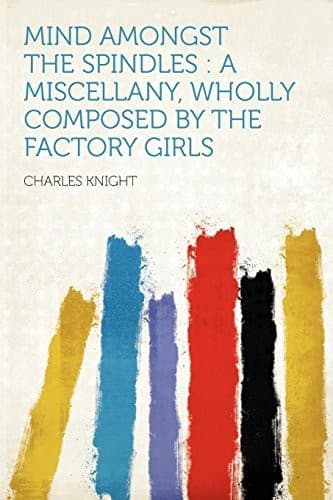
Mind Amongst the Spindles. A Miscellany, Wholly Composed by the Factory Girls
General
Mind Amongst the Spindles. A Miscellany, Wholly Composed by the Factory Girls
American literature -- Massachusetts -- Lowell; American literature -- Women authors; Working class women -- Literary collections
Harriet Greenough had always been thought a spoiled child, when she left
home for Newburyport. Her father was of the almost obsolete class of
farmers, whose gods are their farms, and whose creed--"Farmers are the
most independent folks in the world." This latter was none the less
absolute in its power over Mr. Greenough, from its being entirely
traditionary. He often repeated a vow made in early life, that he would
never wear other than "homespun" cloth. When asked his reasons, he
invariably answered, "Because I won't depend on others for what I can
furnish myself. Farmers are the most independent class of men; and I
mean to be the most independent of farmers."--If for a moment he felt
humbled by the presence of a genteel well-educated man, it was only for
a moment. He had only to recollect that farmers are the most independent
class of people, and his head resumed its wonted elevation, his manner
and tone their usual swaggering impudence.
While at school he studied nothing but reading, spelling, arithmetic,
and writing. Latterly, his reading had been restricted to a chapter in
the Bible per day, and an occasional examination of the almanac. He did
not read his Bible from devotional feeling--for he had none; but that he
might puzzle the "book men" of the village with questions like the
following:--"Now I should like to have you tell me one thing: How
_could_ Moses write an account of his own death and burial? Can you just
tell me where Cain and Abel found their wives? What verse is there in
the Bible that has but two words in it? Who was the father of Zebedee's
children? How many chapters has the New Testament?--How many verses, and
how many words?" Inability or disinclination to answer any and all of
these, made the subject of a day's laughter and triumph.
Nothing was so appalling to him as innovations on old customs and
opinions. "These notions, that the earth turns round, and the sun stands
still; that shooting stars are nothing but little meteors, I think they
call them, are turning the heads of our young folks," he was accustomed
to say to Mr. Curtis, the principal of the village academy, every time
they met. "And then these new-fangled books, filled with jaw-cracking
words and falsehoods, chemistry, philosophy, and so on--why, I wonder if
they ever made any man a better farmer, or helped a woman to make better
butter and cheese? Now, Mr. Curtis, it is _my_ opinion that young folks
had better read their Bibles more. Now I'll warrant that not one in ten
can tell how many chapters there are in it. My father knew from the time
he was eight till he was eighty. Can _you_ tell, Mr. Curtis?"
Public-domain text, read in full here on John Shaqi.
Reviews
Reviews
No reviews yet
Be the first to share your thoughts on this work.
Elsewhere in the archive
Join the Discussion
Join the discussion
Sign in to leave a comment or review.
Sign InorCreate an account