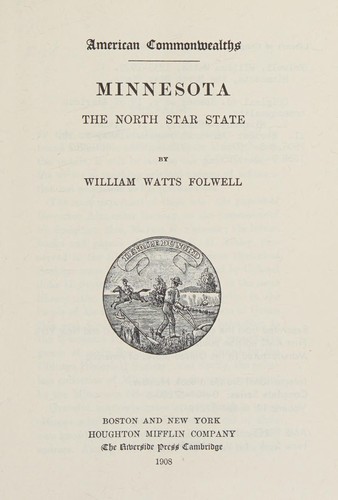
Minnesota, the North Star StateFolwell, William Watts
History
Minnesota, the North Star State
Folwell, William Watts
Minnesota -- History
Forrest leading the last, to rout and capture the little band. The
gallant corporal died the same day, of his wounds. Soon after one
o’clock P. M. the adjutant of the Michigan battalion came out from the
town under flag of truce and safeguard to summon Colonel Lester to the
presence of his colonel. In the interview which succeeded, the
surrender of the Minnesota regiment was recommended. Returning to his
command, Lester summoned his officers to a council. On an open vote the
majority was for fighting. Two company commanders then left the
council. The colonel, not content with the open vote, proposed a
ballot. The result was five to surrender, three to fight. In the
minority were Lieutenant-Colonel Griggs and Captain C. C. Andrews, both
of whom became regimental commanders. It may be said in mitigation of
the action of some of the company commanders voting for surrender, that
as they held their offices by election they felt bound to act in a
representative capacity and not according to their own judgment. The
end of it was the unconditional surrender of the Third Minnesota
without having been seriously attacked. The enlisted men were paroled
and sent to Benton Barracks, St. Louis. The officers were paroled at
Richmond after three months. On December 1 President Lincoln discharged
dishonorably all those who had voted for the surrender.
The Fourth Minnesota regiment was called at the same time as the Third,
but for service on the Indian frontier. The muster began October 2, and
was complete before the close of the year. For colonel Governor Ramsey
chose John B. Sanborn, his adjutant-general, as yet inexperienced in
warfare, but his appointment was later abundantly justified. Two
companies were sent to Fort Ridgely and two to Abercrombie to overawe
the restive Sioux. A fifth company went to Fort Ripley to insure the
good behavior of the Chippeways. The remaining five companies spent the
winter of 1862 at Fort Snelling, where they were thoroughly instructed.
On April 20, 1862, the Fourth Regiment, its absent companies having
been recalled to Fort Snelling, embarked for the South. It reached
Halleck’s army in May in front of Corinth, Mississippi, in time to
partake in the siege which the enemy terminated by a timely evacuation.
After some months of inaction, during which one third of its men got
into the hospital, the regiment participated gallantly in the affair at
Iuka on September 18, losing three killed and forty-four wounded. At
the battle of Corinth, October 3 and 4, the Fourth was actively
engaged, with the surprisingly small loss of two killed and ten wounded.
Public-domain text, read in full here on John Shaqi.
Reviews
Reviews
No reviews yet
Be the first to share your thoughts on this work.
Elsewhere in the archive
Join the Discussion
Join the discussion
Sign in to leave a comment or review.
Sign InorCreate an account