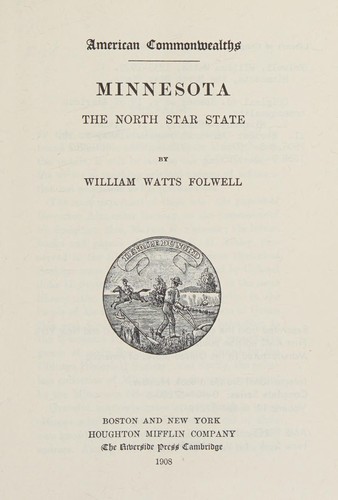
Minnesota, the North Star StateFolwell, William Watts
History
Minnesota, the North Star State
Folwell, William Watts
Minnesota -- History
The winter of 1861-62 was unusually severe. When spring opened food was
scarce in all the villages. The Sissetons had eaten all their horses
and dogs. The farmer Indians had in the previous summer been so
badgered by the unregenerate of their own bands, and by the visiting
Yanktonnais of the plains, that their industry had relaxed, and they
had but little food to spare. The “payment” was accordingly looked to
with unusual eagerness. According to custom it should come as soon as
the grass of the prairies should be fit for pasture. Spring ripened
into summer, but the agents’ runners did not bring the welcome summons
to the villages. The upper Sioux, tired of waiting, came in to the
agency at Yellow Medicine in the middle of July to the number of four
thousand, and with them came one thousand Yanktonnais, literally on the
edge of starvation. The agent supplied some flour, pork, lard, and
sugar and told them to go home. He would call them when he was ready.
But the savages did not depart. In a fortnight they had consumed the
rations and were again hungry. The agent declining to furnish more, an
armed mob of several hundred warriors surrounded the government
storehouse, surprised the little guard of infantry, broke the locks and
bolts, and carried off one hundred sacks of flour. Making a virtue of
necessity, the agent, after a talk in council, agreed to issue all the
provisions and annuity goods, on condition that the Indians would
depart and stay away till called. Trouble with the upper Sioux was thus
tided over, but their respect for the Great Father’s power was not
increased by the forced compliance of his agent.
There was less want of food in the villages of the lower Sioux, but
there was enough to cause distress and desire for an early payment. The
agent had no advices. He could give no reasons for the delay of the
money. The traders assumed to know more than he, and with a fatal
blindness teased the Indians with suggestions that the Great Father had
spent all his money and had none left for his red children. As the
Indians were heavily in debt to them, they began refusing further
credits. Among the rumored reasons for the delay of the money, the one
most accepted was that the government officials were allowing friends
to use it in speculations on supply contracts. The fact was that the
Indian appropriation of 1862 was not passed in Congress till July 5.
The gold was drawn from the treasury on August 11, and was at once
dispatched to the west. It was brought to Fort Ridgely at noon on
August 18.
Public-domain text, read in full here on John Shaqi.
Reviews
Reviews
No reviews yet
Be the first to share your thoughts on this work.
Elsewhere in the archive
Join the Discussion
Join the discussion
Sign in to leave a comment or review.
Sign InorCreate an account