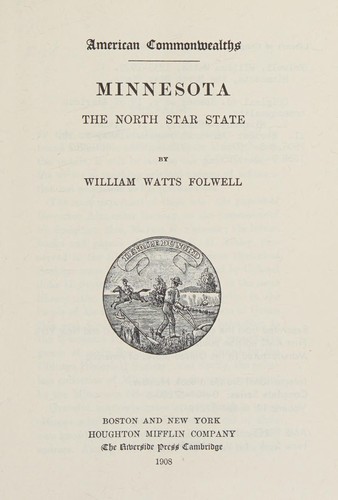
Minnesota, the North Star StateFolwell, William Watts
History
Minnesota, the North Star State
Folwell, William Watts
Minnesota -- History
No Indians appeared on that day or the next. Early on Saturday (August
23) the smoke of scattered fires was seen off to the eastward beyond
the Minnesota. Had Little Crow captured the fort, and were his warriors
burning the farmsteads? To ascertain, Colonel Flandrau sent over a
detachment of seventy-five men, which soon encountered a fire from its
left front and was obliged to retreat to the eastward to meet
reinforcements expected from that quarter. Crow’s real attack came from
the northwest, over the terraced plain stretching along the river above
the town. Flandrau had left some three hundred and fifty men, ill-armed
and undisciplined. When aware of the approach of the Indians, he moved
them out and posted them upon the slope of one of the terraces, with a
line of skirmishers to the front. At eight o’clock Crow’s warriors in a
long line with flanks curved forward moved on in silence till within
about a half mile of the line of defenders. Then raising such a shout
as only savages can, they broke into a run, firing as they ran. The
skirmishers fell back in alarm, and the whole line, spite of the
exhortations, polite and other, of Flandrau and his officers, retreated
to the barricades. The Sioux did not follow in, but stopped and sought
cover in the emptied outer buildings of the town.
The fire returned from the barricades discouraged the Sioux from
attempting an assault. Late in the afternoon a demonstration was made
below the town by a party, some of which wore white men’s clothes. Thus
misled, the brave Captain Dodd, second in command, unduly exposed
himself and was shot to death. Other weak attempts were made by the
persistent Indian leader, which came to naught. Ten of the defenders
were killed and fifty wounded. Flandrau estimated the attacking force
to be six hundred and fifty in number. Expecting a renewal of the fight
on the following morning, Colonel Flandrau ordered the destruction of
all buildings outside his fortification. Including those burned by the
Indians, one hundred and ninety were destroyed. Indians rarely fight by
night; and on Sunday morning they sent in a few long range shots, and
the “Battle of New Ulm” was over.
Nearly two thousand people had been confined in the narrow fortified
space. The women and children had been huddled in the cellars. Food was
failing and sickness breaking out. Their homes destroyed, it was
resolved to move the whole population to Mankato, thirty miles distant.
On Monday morning they took the road; the women, children, and wounded
on wheels, the men and boys on foot, escorted by the extemporized army.
The column reached its destination late at night, and the refugees met
with a generous reception. The next day, August 26, Colonel Flandrau’s
force dissolved.
Public-domain text, read in full here on John Shaqi.
Reviews
Reviews
No reviews yet
Be the first to share your thoughts on this work.
Elsewhere in the archive
Join the Discussion
Join the discussion
Sign in to leave a comment or review.
Sign InorCreate an account