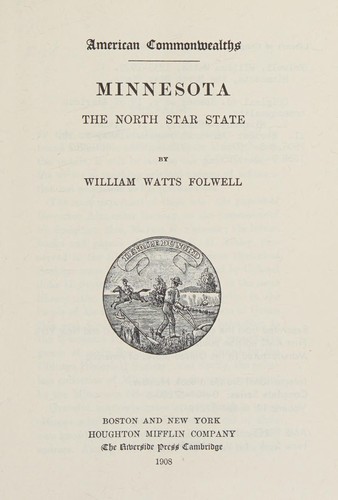
Minnesota, the North Star StateFolwell, William Watts
History
Minnesota, the North Star State
Folwell, William Watts
Minnesota -- History
Yielding to the prayers of refugees in Fort Ridgely, whose relatives
were lying unburied about the ruins of their homes or along the
roadsides, Colonel Sibley decided to send out a burial party which
should also serve as a corps of observation. It marched on the morning
of August 31 under the direction of Major Joseph R. Brown, whom Colonel
Sibley had attached to his staff. His party was made up of Captain H.
P. Grant’s company of the Sixth Infantry, fifty mounted men under
Captain Joseph Anderson, a fatigue detail of twenty, and seventeen
teamsters. The column moved slowly, halting to bury sixteen bodies on
the agency road, and at nightfall bivouacked on the bottom near the
Redwood Ferry. In the morning Major Brown with the mounted men crossed
the Minnesota and scouted through the villages above the agency, to
find them deserted. The infantry force buried some twenty bodies of
Captain Marsh’s men, moved up the north side, struck across the prairie
to the head of Birch Coulie, and went into camp on a singularly
ill-chosen spot, at which Major Brown arrived at sunset. The wagons
were parked in open order, and the animals were tied to picket ropes
stretched between them. Within the circle so formed the party went
early to sleep, some in Sibley tents, but most under the open sky. At
daybreak they were awakened by a blood-curdling yell and a volley of
bullets apparently from all quarters and at short range. Captain
Anderson, who had seen service in the Mexican War, ordered his men to
lie low and fire at will. The infantry commander, after a vain effort
to form his men in line, gave a like judicious order. The savages
maintained a murderous fire for an hour, at the end of which ten of
Brown’s men were killed and forty more wounded, himself included.
Desultory firing continued throughout the day, in the lulls of which
possible arrangements for defense were made. The bodies of over ninety
horses were strung along, and earth, dug up with three spades and one
shovel, and with sabres, bayonets, pocket-knives, and tin plates, was
heaped over them. The pits thus formed served as good cover for the men
who were prudent. At two in the afternoon the boom of a cannon from the
eastward gave notice of approaching relief, but night fell and it did
not come. The sound of the morning’s battle was heard at Sibley’s
outposts, fifteen miles away. With all possible dispatch he sent a
relieving party consisting of three companies of the Sixth Infantry,
fifty mounted “Rangers,” and a section of artillery, and gave the
command to Colonel Samuel McPhail of Houston County. The party crossed
the east branch of Birch Coulie and came within sight of Brown’s camp,
but the prudent commander did not think it wise to risk his men in a
battle. He therefore recrossed the branch, took up a safe position for
the night, and sent Lieutenant Sheehan back to Sibley for
reinforcements. He reached the fort unharmed, but his horse fell dead
soon after from gunshot wounds.
Public-domain text, read in full here on John Shaqi.
Reviews
Reviews
No reviews yet
Be the first to share your thoughts on this work.
Elsewhere in the archive
Join the Discussion
Join the discussion
Sign in to leave a comment or review.
Sign InorCreate an account