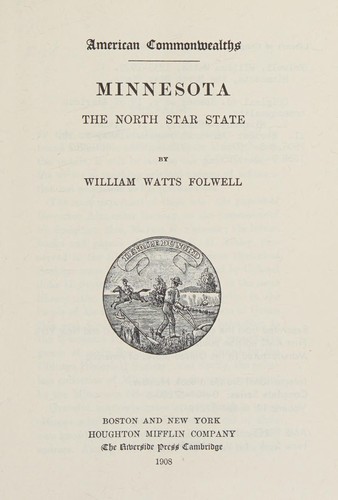
Minnesota, the North Star StateFolwell, William Watts
History
Minnesota, the North Star State
Folwell, William Watts
Minnesota -- History
Had it been possible to furnish General Sibley with a sufficient
cavalry force, it would have been feasible for him, after the battle of
Wood Lake, to overtake and impound the greater number of Indians
concerned in their disastrous campaign. Infantry expeditions sent out
to Lac qui Parle, to Goose Nest Lake, and elsewhere, brought in a few
hundred people. More came in response to a proclamation distributed by
runners. Bands which had squandered their plunder and wasted their food
had no other resource. In the course of a few days nearly two thousand
Indians were under guard, the greater part being women and children.
Some five thousand or more were at large. The disposition of those in
hand now occupied the attention of the authorities. Major-General Pope
in a dispatch of September 28 probably voiced the sentiment of the
great majority of the white people of the Northwest. “Make no treaty
with the Indians,” he wrote Sibley; “the horrible massacre and outrages
call for punishment beyond human power to inflict. It is my purpose to
exterminate the Sioux, if I have the power to do so.” General Sibley
was too humane and judicious to give serious regard to so insane a
proposal. He had already appointed a committee of inquiry to ascertain
what Indians under his guard had probably been guilty of murder and
outrage. The Rev. Dr. Riggs, who held the place of chaplain on the
staff of Sibley, gave such valuable assistance that Heard, the
contemporary historian, declares him to have been a virtual grand jury.
Sixteen Indians were at once picked out by the sifting committee and
duly arraigned before a military commission of five officers.
Additional arrests were made from day to day, and by October 7 General
Sibley was able to report that he had twenty under sentence of death,
and that he should probably approve the sentences and hang the
villains, despite some doubt as to the extent of his powers and the
formal correctness of the trials. This moderate number of convictions
evidently did not satisfy the superior authority, which called for
arrests and trials on a greater scale. On the night of October 11
Sibley placed 81 warriors in irons at Camp Release and ordered a
similar “purging” at Yellow Medicine, where he had sent 1250 of his
prisoners to subsist on the corn and potatoes of the Indian gardens. By
a “piece of justifiable strategy” 236 men were “fixed” in the same way.
The military commission now had abundance of material and applied
themselves diligently to duty. They completed it on November 5, having
tried 392 prisoners, of whom they found 323 guilty and sentenced 307 of
them to death. The proceedings of the military commission, approved by
General Sibley, were forwarded to the department commander. That
officer informed Governor Ramsey with unconcealed satisfaction that the
sentences would all be executed unless forbidden by the President. The
trials completed, General Sibley sent the principal body of his Indian
Public-domain text, read in full here on John Shaqi.
Reviews
Reviews
No reviews yet
Be the first to share your thoughts on this work.
Elsewhere in the archive
Join the Discussion
Join the discussion
Sign in to leave a comment or review.
Sign InorCreate an account