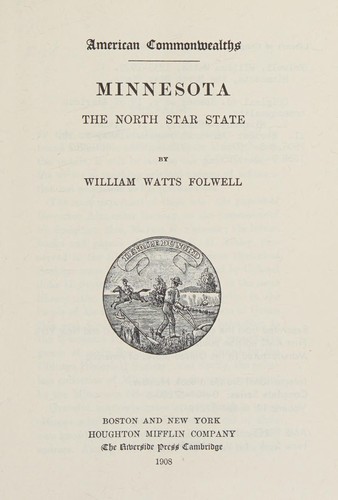
Minnesota, the North Star StateFolwell, William Watts
History
Minnesota, the North Star State
Folwell, William Watts
Minnesota -- History
The homestead act of 1862 contributed not a little to the extension of
settlements in the state. The original bill for that act, passed in
1860 after bitter opposition from Southern senators and
representatives, had been vetoed by President Buchanan on the ground
that the government had no power under the constitution to give away
property of the people held by it in trust. Cyrus Aldrich, one of
Minnesota’s members, introduced and actively supported the later bill,
which became law on February 28, 1862, and took effect January 8, 1863.
In the three years following, 9529 homestead entries were made in
Minnesota, thirty-six per cent. of the whole number. There can be no
question that the operation of the homestead act was beneficial so long
as confined to arable lands. The use made of its provisions in later
years to obtain possession of timber and mineral lands by processes
morally, if not technically, criminal, depriving the nation and states
of untold millions of value, gives room for regret that President
Buchanan’s judgment had not governed his successor.
CHAPTER XV
REVIVAL
It was to be expected that, upon the anticipated retirement of Governor
Miller, General William R. Marshall, the most prominent among the
founders of the Republican party in Minnesota, who had added a highly
honorable military career to his civil record, would be called to
succeed. And he was; but not without opposition from other gentlemen
who had also distinguished themselves in both civil and military
duties. It took twenty-two ballotings in the Republican convention to
secure his nomination. At the polls he met that veteran of Democracy,
the Hon. Henry M. Rice, whose popularity, especially among “old
Territorians,” was so great as to reduce his majority to less than 3600
in a total of 31,000 votes. He took office in January, 1866, and so
commended himself by a judicious practical administration that his
reëlection in the fall of the following year was but formally
contested. Mr. Rice closed his political career with the campaign of
1865, which he survived for a quarter of a century.
Marshall’s double term was a period of recovery and repair after the
exhaustion of the wars; and it was something more. Neither the people
severally nor the state were heavily burdened with debt, and there was
work for all and good prices for produce. Railroad building was
continued on a scale of a few more than one hundred miles a year. In
1867 the line now known as the Iowa and Minnesota Division of the
Chicago, Milwaukee and St. Paul Railroad, begun at both ends, was
completed, and trains were put on from the Falls of St. Anthony to
Prairie du Chien, whence rail connection eastward already existed.
Minnesota was now in the great world all the year round. No important
terminals were reached by additions to other lines, although seven
hundred and sixty-six miles had been constructed by the close of the
decade.
Public-domain text, read in full here on John Shaqi.
Reviews
Reviews
No reviews yet
Be the first to share your thoughts on this work.
Elsewhere in the archive
Join the Discussion
Join the discussion
Sign in to leave a comment or review.
Sign InorCreate an account