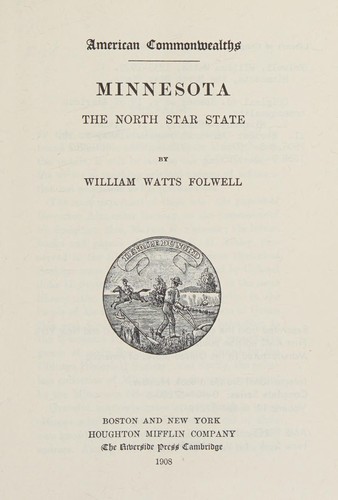
Minnesota, the North Star StateFolwell, William Watts
History
Minnesota, the North Star State
Folwell, William Watts
Minnesota -- History
In 1858 a bill had been worked through the first state legislature to
establish three normal schools, one at Winona as soon as practicable
after passage, the others at times to be later determined. This bill
was fathered by Dr. John W. Ford of Winona, an enthusiast in the cause
of professional education for teachers. So little was known in the
longitude of Minnesota of what a “normal school” might be, that it is
not strange that the friends of the bill got more credit in the
newspapers and among the people for securing a state institution for
each of three towns than for zeal in the cause of education. Six years
passed before a beginning was made in the first state normal school at
Winona, under the charge of William F. Phelps, an Oswego graduate. No
man less confident of the righteousness of his cause, nor less willing
to fight a bitter opposition, could have built up a school for teachers
which has served as model for many others in Minnesota and other
states. The second state normal school was opened in Mankato in 1868;
the third in St. Cloud in the next year.
The “wing and extension” of the great building planned for the
territorial regents of the university in 1856, and built in that year
and the next, stood empty for ten years, except that at different times
private teachers were allowed to hold their classes in some of the
rooms. The legislature of 1858 authorized the regents to borrow $40,000
and issue ten per cent. bonds in evidence of debt. These securities
were negotiated in New York after great effort and at a ruinous
discount. The claim was later made that they could not have been
disposed of at all had they not been improperly represented to be
virtually bonds of the state. The proceeds released the regents from
obligations which they had personally assumed and satisfied a portion
of the creditors.
The Republican legislature of 1860 thought it time to oust the “old
Democratic board” and install a new administration. The new “state
board,” consisting of three members _ex-officiis_ and five appointed,
had nothing to report to the next session but a debt of $93,500,
including $8000 of overdue interest. Their recommendation was that the
land grant be turned over to the creditors, the campus and building
being retained. An act of Congress of March 2, 1861, donating to the
state the university lands “reserved” for the territorial university,
rendered such action feasible.
Public-domain text, read in full here on John Shaqi.
Reviews
Reviews
No reviews yet
Be the first to share your thoughts on this work.
Elsewhere in the archive
Join the Discussion
Join the discussion
Sign in to leave a comment or review.
Sign InorCreate an account