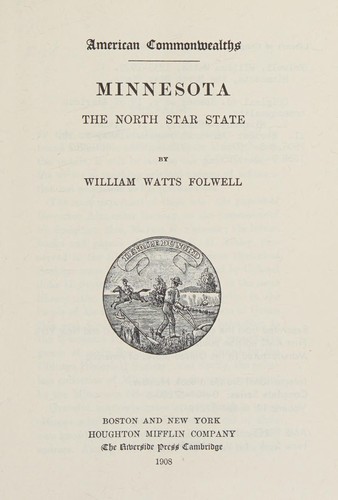
Minnesota, the North Star StateFolwell, William Watts
History
Minnesota, the North Star State
Folwell, William Watts
Minnesota -- History
The special board, having accomplished its purposes to the satisfaction
of all concerned, recommended to the legislature of 1868 the transfer
of control to a permanent board of regents. The act of February 18,
1868, passed in pursuance of this counsel, is the charter of the
university, and has not been materially modified. The new board
appointed by the governor with the consent of the senate properly
contained the names of Pillsbury, Nicols, and Merriman. At the close of
the school year of 1869 the regents resolved to open the “College of
Science, Literature, and the Arts,” as the statute ambitiously named
the academic department. Although there were but fourteen provisional
freshmen and a hundred and fifty preparatory students, a president,
eight professors, and one instructor were elected. The faculty thus
constituted organized in September, and took up the work before them,
mostly that of a fitting school.
The title of the charter of February 18, 1868, contained the clause,
“and to establish an agricultural college therein.” The original act of
1851 creating the university named as one of its five departments that
of agriculture, but on March 10, 1858, a separate “state agricultural
college” was established and located at Glencoe in McLeod County.
Minnesota’s share of the so-called Morrill land grant of 1862 for the
benefit of colleges of agriculture and the mechanic arts was 120,000
acres. By an act approved March 2, 1865, the proceeds of this grant
were applied and appropriated to the said agricultural college of
Minnesota. What influences or interests prevailed to induce the people
of McLeod County to consent to the merger of their institution with the
university are not well known, but the legislature of 1868 decided on
that policy, and inviolably appropriated the income of the Morrill land
grant to the united institutions. The friends of the university were,
of course, gratified over the return to the scheme of the original
creative act of 1851 and the concentration of the state’s resources for
the higher education. Governor Marshall had the satisfaction of seeing
the University of Minnesota, in which he had been deeply interested
from its statutory creation, at length fairly launched on a career of
promise which he lived to see fulfilled. He had also the gratification
of seeing the color line removed from the state constitution by the
adoption, at the election of 1868, of an amendment expunging the word
“white” out of the article on the elective franchise. A much needed
revision of the laws of the state went into effect about the same time.
* * * * *
Public-domain text, read in full here on John Shaqi.
Reviews
Reviews
No reviews yet
Be the first to share your thoughts on this work.
Elsewhere in the archive
Join the Discussion
Join the discussion
Sign in to leave a comment or review.
Sign InorCreate an account