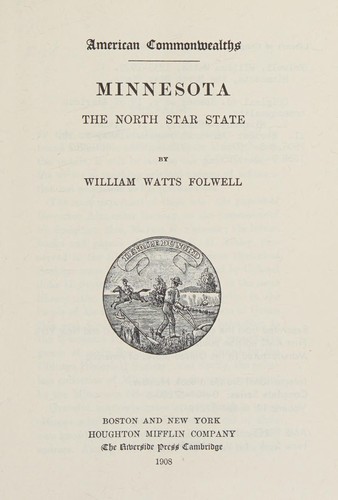
Minnesota, the North Star StateFolwell, William Watts
History
Minnesota, the North Star State
Folwell, William Watts
Minnesota -- History
The same legislature (1871) provided for the appointment by the
governor of a state railroad commissioner to observe the behavior of
the corporations under the new law. The first incumbent was General
Alonzo J. Edgerton, who had given proof of ability by gallant military
service and successful practice as an attorney. The three reports of
this official are a pitiful record of the unequal struggle of the
legislatures with their informally confederate creatures, the railroad
corporations. To the regulative act of 1871 the corporations gave not
the slightest heed, partly on the ground of their rights as
quasi-persons, partly because in their territorial charters they had
been authorized to make “reasonable charges” for services, and the
legislature had not reserved the right to determine what charges were
reasonable. If some of the roads somewhat abated their rates, it was
not because of the legal mandate. Gross discriminations continued to be
practiced. The evasion of taxes by the companies by various devices
added to public exasperation. The commissioner was gratified to have
exacted an increase of railroad taxes from $56,505.54 in 1871 to
$106,876.35 in the year after, and regretted his inability to reach
$250,000 more illegally withheld. One company, the Minnesota Central,
sold its entire railroad property to the Milwaukee interest, retaining
its unsold lands, and claimed to survive as a railroad company entitled
to hold its lands free of taxation. For lack of authority to make
personal inspections of company accounts and property the commissioner
could not verify their reluctant reports, which, because not made on a
prescribed uniform plan, were of slight practical service. In his
report for 1873 he reminded the legislature that the companies, which
had by the beginning of that year constructed 1900 miles of road, had
received from the nation, state, and municipalities, grants and gifts
to the value of $51,000,000, being about $27,000 per mile of completed
road. The average necessary cost of construction and equipment,
according to an expert computation, would have been a trifle over
$23,000 to the mile. In that year the bonded debt of the roads amounted
to $54,500,000. The aggregate of capital stock, $20,000,000, raised the
“capitalization” of the roads to $74,500,000; nearly $48,000 per mile.
Only nominal amounts of stock-proceeds had gone into construction and
equipment, and there were wide margins between the face value of the
bonds sold and the actual expenditures. In some instances, says the
commissioner, not more than forty per cent. went into construction. In
these years in which building was going on so swimmingly, operation was
far from encouraging. The managers had been more concerned to increase
mileage than to build substantially. Heavy grades, sharp curves, and
slight construction were the result. The iron rails weighed for the
most part but fifty pounds to the yard. Equipment corresponded, of
course, with track and rail.
Public-domain text, read in full here on John Shaqi.
Reviews
Reviews
No reviews yet
Be the first to share your thoughts on this work.
Elsewhere in the archive
Join the Discussion
Join the discussion
Sign in to leave a comment or review.
Sign InorCreate an account