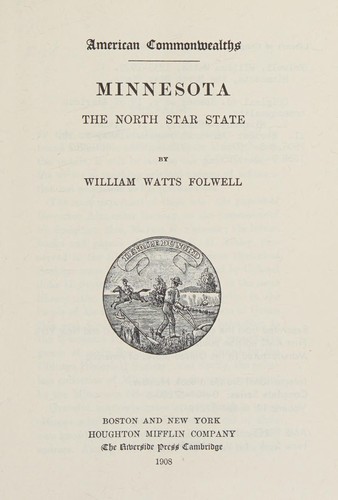
Minnesota, the North Star StateFolwell, William Watts
History
Minnesota, the North Star State
Folwell, William Watts
Minnesota -- History
The morning of January 7, 1873, opened clear and bright over the south
half of Minnesota, with no signs of foul weather in the sky. The
country people had left their homes on their usual errands to mill, to
post-office, to town, to distant wood lots or fields, without thought
of danger. Soon after midday those who were still on the road were
overtaken by one of those terrible winter storms known to old voyageurs
as “blizzards.” The most learned authority in America on English usage
has recently made the statement that the word “blizzard” is not more
than twenty-five years old. It was in common use in Minnesota in the
fifties. In a true blizzard the air is so completely filled with a fine
granular snow as to cause absolute darkness. It is, as on this
occasion, frequently accompanied by a furious wind. The temperature may
or may not be excessively low. The voyageur did not attempt to travel
when a blizzard overtook him, but got behind and beneath such shelter
as he could find or make, and waited for it to blow over. These
inexperienced Minnesota settlers pressed on, wandered from the unfenced
roads, and if they found shelter it was by good fortune. Many perished
in the terrible gusts which swept the prairie. The weather did not
clear till the third day. The first accounts estimated the number of
lives lost at many hundreds, but when the state statistician collated
the local reports sent in he was happy to find that not more than
seventy persons had perished. A much greater number, of course, were
frost-bitten and maimed. There were cases in which farmers had been
either injured or destroyed while attempting to reach their houses from
their barns and fields. There has been no blizzard of any notable
severity in Minnesota since this of 1873.
In June of the same year a southwest wind brought over the western
border, south of Big Stone Lake, swarms of the Rocky Mountain locust
(_Melanoplus spretus_), which soon spread themselves over large parts
of fourteen southwestern counties as well as a considerable area of
northwestern Iowa. Because not learned enough in entomology to
distinguish, the people supposed these locusts to be grasshoppers, and
soon adopted the abbreviated form “hoppers.” The growing crops were
presently devoured. Settlers who had made their first plantings were
impoverished and had to accept the generous aid of neighbors. The area
visited was small compared with that of the state and its settled
portions, and it was not conceived that grasshoppers could survive a
Minnesota winter. The legislature of 1874 made an appropriation of
$5000 to relieve cases of complete destitution, and another of $25,000
to be advanced to the farmers for the purchase of seed.
Public-domain text, read in full here on John Shaqi.
Reviews
Reviews
No reviews yet
Be the first to share your thoughts on this work.
Elsewhere in the archive
Join the Discussion
Join the discussion
Sign in to leave a comment or review.
Sign InorCreate an account