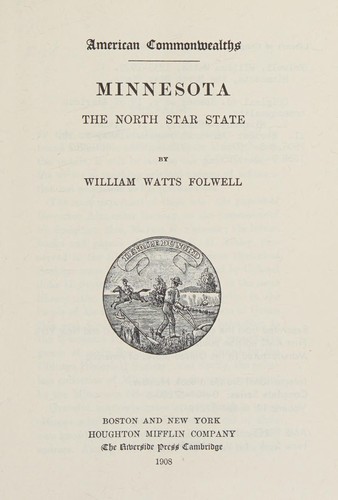
Minnesota, the North Star StateFolwell, William Watts
History
Minnesota, the North Star State
Folwell, William Watts
Minnesota -- History
President Grant in his message of 1872 advised the Congress to
authorize a committee to investigate the various enterprises for the
more direct and cheaper transportation of the products of the West and
South to the seaboard. The Senate responded by the appointment of a
select committee on transportation routes to the seaboard, with ample
powers for investigation. Senator Windom, as chairman of this
committee, devoted many months to the analysis and interpretation of
the great mass of information and counsel submitted, and to the
preparation of the report in two octavo volumes, printed in the spring
of 1874. Among the novel conclusions of this committee (and some of
them are after the lapse of a generation not familiar to all) were: (1)
that the power of Congress to regulate commerce among the several
states includes the power to aid and facilitate it by the improvement
or creation of channels and ways of transportation; Congress has the
same right to build railroads as canals: hence, (2) the ownership or
control of one or more double-track freight railways; (3) the
improvement of our great natural water ways and their connection by
canals; (4) particularly the improvement of four great channels at
national expense. These were the Mississippi River itself, a route from
the upper Mississippi by way of the great lakes, a route from the same
river by way of the Ohio and Kanawha, and, last, a route from the
Mississippi via the Tennessee; all to be pieced out either by canals or
freight roads. At the present writing Congress is just warming up to
attack the first of these four great enterprises.
As might be supposed, the committee incidentally suggested complete
publicity of all interstate railroad classifications and rates, the
prohibition of combinations with parallel or competing lines, the
receipt for and delivery of grain by quantity, the making it unlawful
for railroad officers to be interested in car or freight line
companies, and the absolute cessation of stock watering. The
proposition of a bureau of commerce to supervise all interstate
railroad operations bore fruit twelve years later in the interstate
commerce commission. Senator Hoar declared this report to be “the most
valuable state paper of modern times.”
Public-domain text, read in full here on John Shaqi.
Reviews
Reviews
No reviews yet
Be the first to share your thoughts on this work.
Elsewhere in the archive
Join the Discussion
Join the discussion
Sign in to leave a comment or review.
Sign InorCreate an account