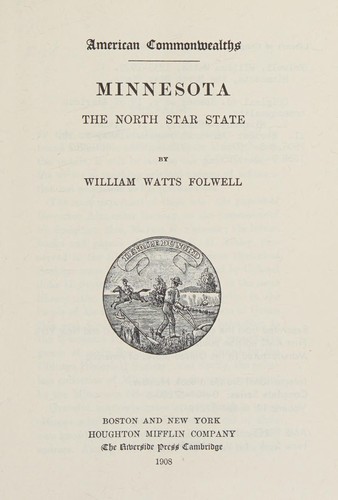
Minnesota, the North Star StateFolwell, William Watts
History
Minnesota, the North Star State
Folwell, William Watts
Minnesota -- History
have been converted from a loose aggregation into a complete,
harmonious, organized system. There is open to every child of the state
a course of free school education from the kindergarten to the
doctorate of philosophy.
* * * * *
On May 2, 1878, soon after seven o’clock in the evening an explosion
took place in the Washburn flour mill in Minneapolis. The report was
heard at great distances, the windows in neighboring streets were
shattered, and not one stone of the great building was left on another
above the foundations. Two other mills of less capacity, standing near,
blew up within a few seconds, and three others took fire and were
completely destroyed. It was the hour for the change of shift of day to
night crews, or many more than eighteen men would have lost their
lives. The insurance companies, when called upon to pay their losses,
demurred, taking the ground that they had insured against fire only,
and not against chemical explosion. Mr. Louis Peck, the instructor in
physics in the University of Minnesota, attracted by the problem,
conducted an exhaustive course of experiments to ascertain the truth of
the matter. Some of them were exhibited to the public. His conclusion
was that the mills were destroyed by a true fire. He found that any
carbonaceous dust, flour, starch, or even sawdust, diffused through the
atmosphere, would take fire and burn with an incalculable rapidity from
a spark or flame. His testimony compelled the payment of the
insurances. The statement of a Minnesota historian that this excellent
bit of scientific work was done by a professor in Berlin is erroneous.
Even more disastrous was a fire which on November 15, 1880, destroyed a
wing of the hospital for the insane at St. Peter. Twenty-seven patients
lost their lives. The state capitol, erected in 1853, took fire in the
evening of March 1, 1881, while the senate was in session, and was
completely destroyed. Fortunately no lives were lost, but the senators
made their escape none too soon. The ceiling fell as the last of them
reached the street.
The Fourth of July, 1880, was the two hundredth anniversary of the
discovery of the Falls of St. Anthony by Father Louis Hennepin. The
event was commemorated by a celebration held on the university campus,
under the management of the Minnesota Historical Society, General
Sibley presiding. The principal address was delivered by Mr. Cushman K.
Davis. Archbishop Ireland charitably defended the Franciscan father
from charges of untruthfulness on the ground that unauthorized
interpolations were made in his original book. General William T.
Sherman was present, and was heard in some happy extemporaneous remarks.
* * * * *
Public-domain text, read in full here on John Shaqi.
Reviews
Reviews
No reviews yet
Be the first to share your thoughts on this work.
Elsewhere in the archive
Join the Discussion
Join the discussion
Sign in to leave a comment or review.
Sign InorCreate an account